Melbourne Mint, Historical mint building in Melbourne, Australia
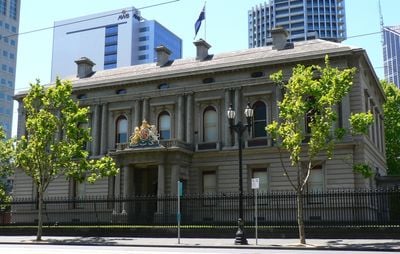
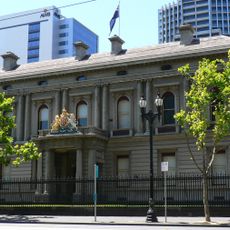
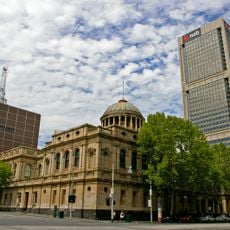
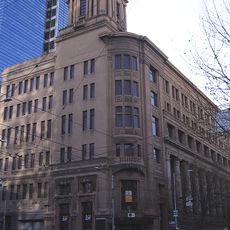
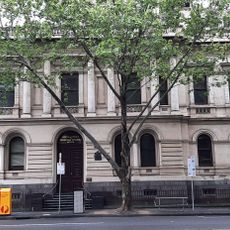
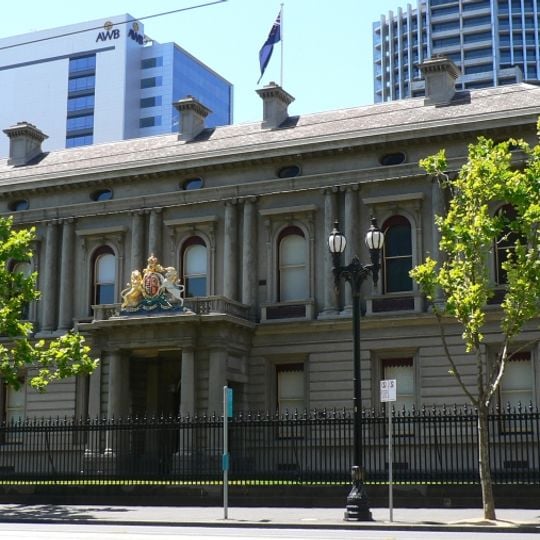
The Melbourne Mint is a two-storey stone building on the corner of William and La Trobe Streets, designed by Public Works architect J. J. Clark and built between 1869 and 1872. Its rusticated lower storey has tall arched windows framed by pilasters and a central entrance reached by steps; above the door sits a carved coat of arms flanked by two figures. The upper storey carries arched sash windows in recessed panels, and a low parapet with small gabled pediments caps the roofline. A black iron palisade fence runs along the front boundary.
Operations began in 1872, producing gold sovereigns, half-sovereigns, and Commonwealth silver coins for several decades. Minting moved to the Royal Australian Mint in Canberra in 1968, marking the end of local coin production.
Since 2007 the former mint has housed the Hellenic Museum, showing Greek art, history and culture. Earlier the surviving administration building served the Royal Historical Society of Victoria and the civil marriage registry, whose weddings filled the large ground-floor room.
The building stands at the corner of William and La Trobe Streets, at 280–318 William Street and 387–429 La Trobe Street. The surviving structure is the former administration block; the range behind that held the assay and smelting works and the coin-minting equipment was demolished after 1969. The Hellenic Museum has occupied the former mint since 2007.
The coat of arms on the front gates was carved in the mid-20th century by Melbourne woodcarver Walter Langcake. Adapted from Queen Victoria's arms for a colonial branch of the British Royal Mint, it shows the supporting animals uncrowned, with a maned horse in place of the usual unicorn.
The community of curious travelers
AroundUs brings together thousands of curated places, local tips, and hidden gems, enriched daily by 93,895 contributors worldwide.