Mohaka Viaduct, Truss bridge in Raupunga, New Zealand
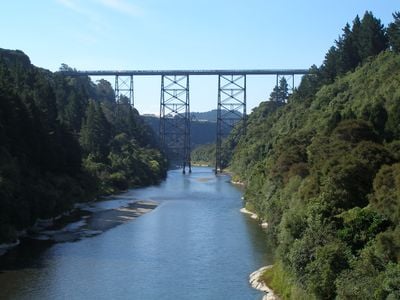
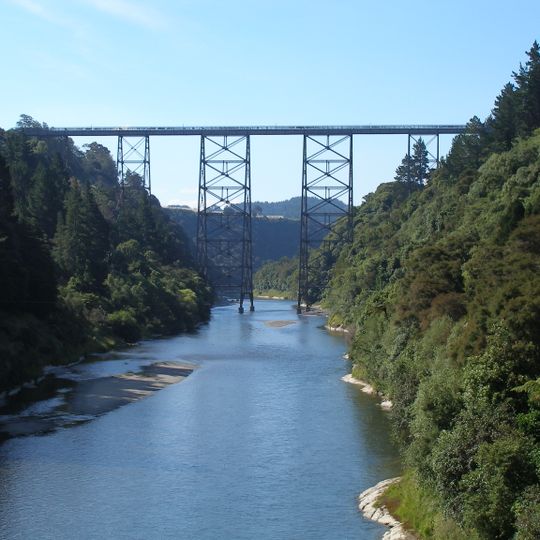
The Mohaka Viaduct is a steel truss bridge in the northern Hawke's Bay region of New Zealand, crossing the Mohaka River at around 95 meters above the water. The structure runs nearly 280 meters in length and carries trains on the Palmerston North-Gisborne Line.
Engineers John Lelliot Cull and William Langston Newnham designed the bridge in 1930, but the Great Depression and the 1931 Hawke's Bay earthquake pushed back its completion to 1937. Both events, coming one after the other, stalled the project for years.
In 1990, the Institution of Professional Engineers New Zealand placed a commemorative plaque on the viaduct as part of the country's 150th anniversary celebrations. The gesture reflects how the bridge is seen as a reference point in the history of New Zealand engineering.
The viaduct is in a remote area and is easiest to reach on foot from the river valley below. From that lower vantage point, the full height and span of the bridge stand out clearly against the open sky.
The steel parts were not put together on the ground at the site but were carried across the river as prefabricated pieces using a cable-way system. Thanks to this method, the entire structure went up in just seven months.
The community of curious travelers
AroundUs brings together thousands of curated places, local tips, and hidden gems, enriched daily by 91,644 contributors worldwide.