Port of Tauranga, Commercial shipping port in Bay of Plenty, New Zealand
Port of Tauranga occupies both sides of a natural harbour sheltered by Mount Maunganui and Matakana Island. Its 15 berths include 12 on the Mount Maunganui side, with 2,055 m of continuous berth face, cargo sheds and a 20,000-tonne coldstore, and 3 at the Sulphur Point container terminal, opened in 1992 with 770 m of wharf, nine Liebherr cranes and 53 straddle carriers.
The first wharf was built in the 1860s; before that, cargo was handled from the beach. In September 1873 Governor-General Sir James Fergusson formally established the port, and the 2,138-tonne Lady Jocelyn entered the harbour in 1882. A harbour board took over administration in 1912, meeting for the first time in 1913. Timber became the main export cargo after the James Cook loaded timber for Australia in 1948.
Timber has been the port's main export cargo since the James Cook loaded it for Australia in 1948. In 2013 forestry products made up about 60% of exports, followed by dairy at 12.9% and kiwifruit at 5.4%; imports were led by oil at 20.7% and fertiliser at 6.4%. Most trade partners are in Asia, which took 65.4% of exports.
The port has 15 berths: 12 on the Mount Maunganui side for wood, coal and bulk liquids, and 3 at the Sulphur Point container terminal on the Tauranga CBD side. The two sides face each other across the harbour, so pick your viewpoint by which traffic you want to see. This is a working port, not a visitor site.
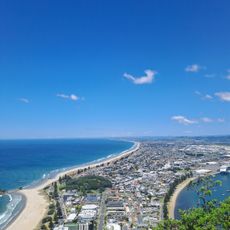
The harbour's only sea entrance runs through the Tauranga Entrance, the strait between Matakana Island and Mauao, the old volcanic cone that rises straight from the sea. Ships bound for the wharves pass through this narrow gap, which is why the port is sheltered in all weathers.
The community of curious travelers
AroundUs brings together thousands of curated places, local tips, and hidden gems, enriched daily by 93,459 contributors worldwide.