Farrington House, Alderley, Heritage-listed house in Alderley, Brisbane, Australia
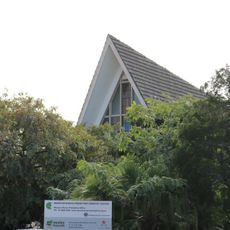
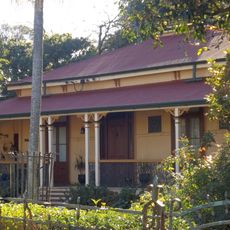
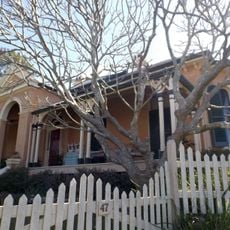
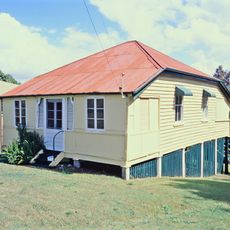
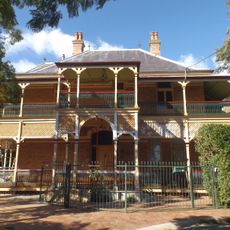
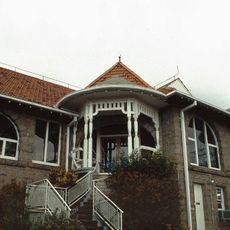
Farrington House sits on a hilltop at David Street and is a single-story timber building with verandahs and dormer windows throughout its design. The structure shows Victorian elements mixed with Carpenter Gothic features that were typical of wealthy residences during that period.
Farrington House was built around 1882 for Frederick Waters Wilson, whose FW Wilson & Co steam biscuit factory, established in 1874, was the first of its kind in the colony. The estate was rented from the mid-1890s, and in 1915 David Henry Rhoades subdivided it down to 2 acres. Colonel Henry William Lee lived here from 1917 to 1930, and during his occupation the house switched from kerosene lighting to electricity and gained a telephone.
The front door's leadlight panel carries the words "Farrington House" and the motto "Dulcius ex Asperis". The cast-iron balustrade is signed by John Grase and dated 14 December 1883, and its handrail is shaped like a bread loaf, a nod to Frederick Waters Wilson's biscuit trade. The house was a social venue for Colonel Henry William Lee's children, several of whom were married there.
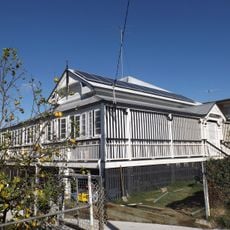
The house is a private residence at 39 David Street and is not open to visitors, so it can only be seen from the street. It stands on a hilltop with 360° views over Brisbane, and the original garden and orchard are largely gone, though the well remains. The timber building has verandahs on four sides and a corrugated iron gabled roof with dormer windows.
The front door's leadlight panel carries the motto "Dulcius ex Asperis", and the cast iron balustrade is signed by John Grase, registered 14 December 1883. Two stained glass windows of c. 1882, signed by Ashwin and Falconer of Pitt Street, Sydney, were removed from the house in recent years.
The community of curious travelers
AroundUs brings together thousands of curated places, local tips, and hidden gems, enriched daily by 92,926 contributors worldwide.