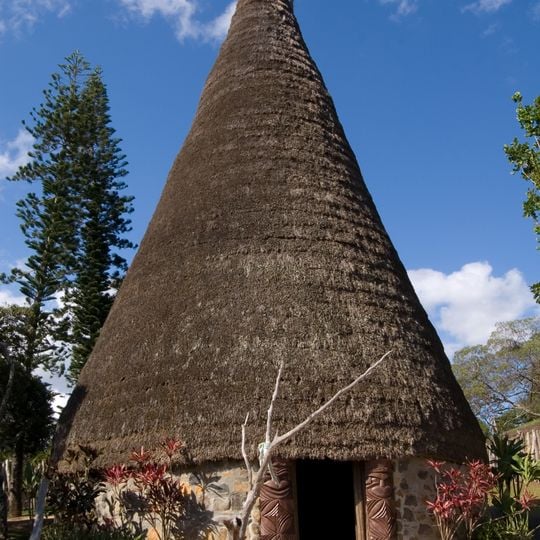
Jean-Marie Tjibaou Cultural Centre, Cultural center on Tina Peninsula, Nouméa, New Caledonia
The Jean-Marie Tjibaou Cultural Centre is a cultural facility on the Tina Peninsula consisting of ten pavilions shaped like traditional Kanak huts. These buildings are linked by pathways running through gardens across an eight-hectare site.
Planned under the 1988 Matignon Accords and named after the Kanak independence leader Jean-Marie Tjibaou, assassinated in 1989, the centre was built between 1995 and 1998 to Renzo Piano's design, chosen in 1991. Lionel Jospin inaugurated it on 4–5 May 1998 as the Nouméa Accord was signed, and it opened to the public on 15 June 1998.
The centre is named simply Centre culturel Tjibaou, not Centre culturel kanak Jean-Marie Tjibaou; customary chiefs explained this at the May 1998 inauguration, when the Tjibaou clan held a ceremony consecrating the gift of their name. It is run by the Agency for the Development of Kanak Culture (ADCK), created in 1989 and transferred to New Caledonia in August 2012, and combines a museum, media library, congress hall, performance venue and botanical park.
The centre lies on the narrow Tina Peninsula, about 8 km northeast of Nouméa's old centre, between the Tina and Magenta bays. The ten pavilions are arranged along a 230-metre arc on a ridge, with a lower flat building and a central alley linking them. The site covers 8 hectares, with mangroves on the lagoon edge and strong easterly winds on the bay side.
Italian architect Renzo Piano designed the buildings to use natural ventilation through wooden slats and thermal chimneys instead of air conditioning. This approach connects to traditional Kanak building methods.
The community of curious travelers
AroundUs brings together thousands of curated places, local tips, and hidden gems, enriched daily by 92,663 contributors worldwide.