Pabellón de rayos cósmicos, Scientific research building in University City, Mexico
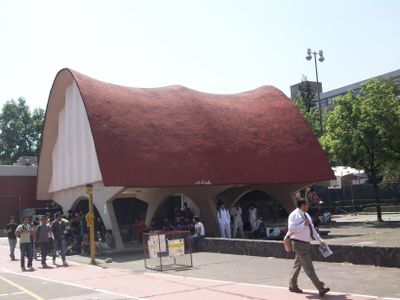
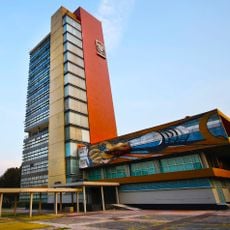
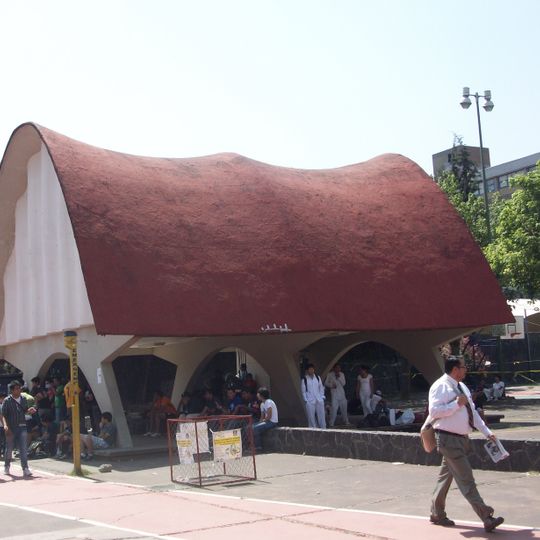
The Cosmic Ray Pavilion is a laboratory building with an unusual hyperbolic paraboloid shape and an extremely thin roof at its highest point. The structure is supported by three arched concrete supports and contains two laboratory spaces connected by an entry lobby.
Jorge González Reyna and Félix Candela built this laboratory in 1951 to measure neutrons and study cosmic radiation from space. The project marked an important step in the university's scientific development during that era.
The building sits between the Faculties of Medicine and Dentistry, where it earned the nickname 'La Muela' from the university community. Students and staff used this everyday name because its shape resembled a tooth.
The building is located on the university campus and is accessed through stairs that lead to the entry lobby. Visitors should know that this is an active research facility and access may be limited depending on ongoing research activities.
The roof employs a mathematical shape that transfers loads directly to the foundation without needing thick material. This innovative approach was a groundbreaking example of modern engineering when it was completed.
The community of curious travelers
AroundUs brings together thousands of curated places, local tips, and hidden gems, enriched daily by 92,018 contributors worldwide.