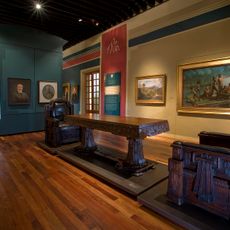
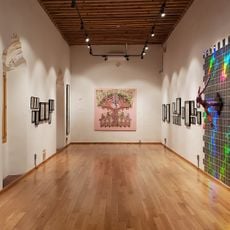
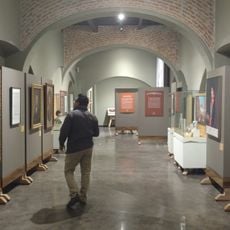
Casa de la Corregidora, Baroque building in Santiago de Querétaro, Mexico.
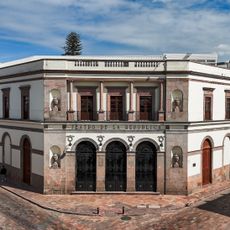
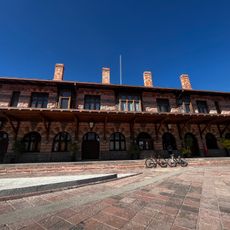
Casa de la Corregidora is an 18th-century building on the north side of Plaza de Armas, at the corner of 5 de Mayo and Pasteur in Santiago de Querétaro. Its two-storey cream-white facade has a flat roofline with small pinnacles, a curved central gable holding a bell, and reddish-brown awnings over wrought-iron balconies. A tall dark sculptural form stands on the pavement in front.
Built in the 18th century as the Casa de los Corregidores, it served as a royal house and jail. On 15 September 1810 Miguel Domínguez, the corregidor, arrested his friends and locked his wife Josefa Ortiz in the building; from an upper room she alerted Ignacio Pérez through the keyhole of the street door. After independence it became the Government Palace; Tomás Mejía seized it in 1856 and 1857, and Maximilian discussed the siege there in 1867. It was the municipal palace until 1981, when José López Portillo reopened it as the seat of the state executive.
The name comes from Josefa Ortiz de Domínguez, wife of the corregidor Miguel Domínguez; she held no office herself, but people called her "la Corregidora". In 1810 the couple took part in meetings of independence sympathizers disguised as literary gatherings. From an upper room she alerted Ignacio Pérez by striking the floor with her heels, and passed the message through the keyhole of the street door.
The building stands on the north side of Plaza de Armas, at the corner of 5 de mayo and Pasteur streets, in the historic centre inscribed by UNESCO in 1996. It has served as the seat of Querétaro's executive power since 25 July 1981, so parts remain working government offices; visitors should expect to view the facade and entrance hall rather than tour the whole building.
The west wing once held the city jail, where the bandits Chucho el Roto and La Carambada were imprisoned. In 1981 the inmates were moved to a new prison in San José del Alto so the building could be restored, and President José López Portillo reopened it as the Government Palace on 25 July 1981.
The community of curious travelers
AroundUs brings together thousands of curated places, local tips, and hidden gems, enriched daily by 94,115 contributors worldwide.