Hartman Prehistoric Garden, botanical garden in Zilker Botanical Garden, Austin, Texas, United States
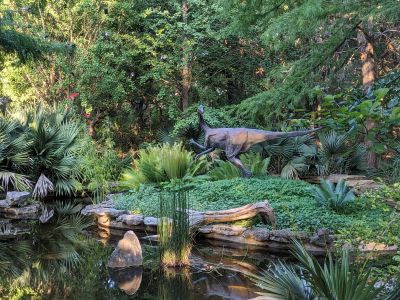
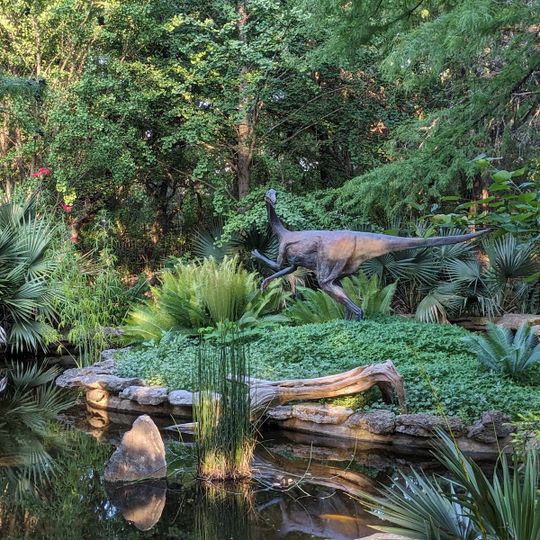
The Hartman Prehistoric Garden is a two-acre garden within the Zilker Botanical Garden in Austin, Texas, laid out as a Cretaceous habitat around an old limestone quarry. It holds over 100 species believed to have grown about 70 million years ago, among them ferns, horsetails, liverworts, cycads, conifers, ginkgos, magnolias and palms. A life-size bronze Ornithomimus by John Maisano stands on an island in the main pond.
In January 1992 Karen and Dr. Mike Duffin found dinosaur footprints in an old limestone quarry in Zilker Park, cleared for a butterfly garden. Professor Wann Langston of the Texas Memorial Museum studied the site; over 100 tracks from six or seven reptiles and an ancient turtle's bones were recorded, mapped and cast, then reburied. The Hartman Foundation of West Lake Hills funded the 2-acre Cretaceous habitat, organized by Claudette Hartman.
The garden is named for the Hartman Foundation of West Lake Hills, whose funding drive and volunteers, organized by Claudette Hartman, turned the quarry into a Cretaceous habitat. The plants were procured, designed and installed by Dr. Craig Nazor, who chose over 100 species believed to have grown here around 70 million years ago, among them ferns, horsetails, liverworts, cycads, conifers, ginkgos, magnolias and palms.
The garden lies within the Zilker Botanical Garden at 2220 Barton Springs Road in Austin. The dinosaur tracks are reburied for protection, so visitors see the Cretaceous plantings and the bronze Ornithomimus on its pond island rather than exposed fossils. The site covers about two acres, with paths winding among ferns, cycads, palms and ginkgos.
A life-size bronze sculpture of an ornithomimus dinosaur stands on an island in the pond, representing the very creature whose three-toed tracks were actually discovered on this site millions of years ago. This direct connection between the sculpture and the real fossil evidence makes the garden a uniquely tangible way to grasp the dinosaur era.
The community of curious travelers
AroundUs brings together thousands of curated places, local tips, and hidden gems, enriched daily by 92,883 contributors worldwide.