Stela of the cactus-bearer shaman, Stone stele in Chavin de Huantar, Peru
The Stela of the cactus bearer is a single-piece granite monolith in the northwest quadrant of the circular plaza at Chavín de Huántar. Carved in shallow relief, the figure faces forward holding a tall ribbed cactus staff in its right hand and a rectangular object marked with curved and hook shapes in its left. It has a wide eye, broad nose, fanged mouth and a headdress, with feet pointing outward at the base.
The stone was created around 750 BC by Chavin people as part of their religious centers. In 1972, archaeologist Luis Guillermo Lumbreras discovered this monolith during excavations in the northwestern area of the circular plaza.
The stela is the clearest iconographic evidence for the ancestral ritual use of the Trichocereus macrogonus cactus in the Andes. The carved figure carries the ribbed cactus staff, and the row of headstones shows anthropomorphic beings processing toward the east stairway, interpreted as priests, musicians and dancers moving with jaguars toward the Lanzón gallery.
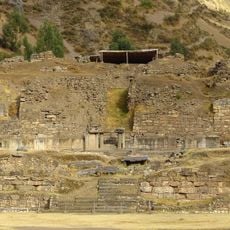
The monolith sits in the circular plaza within the Chavin de Huantar complex and can be reached through the eastern or western entrances. The location is easy to access and requires no special conditions to view the stone.
The 2001 fragment, found by John W. Rick's Stanford team, preserves the figure's left leg, a serpent hanging from its belt, and the lower cactus stem and root. It indicates the slabs were matched pairs: two facing right and two facing left, all oriented toward the stairway descending west from the Lanzón gallery.
The community of curious travelers
AroundUs brings together thousands of curated places, local tips, and hidden gems, enriched daily by 92,875 contributors worldwide.