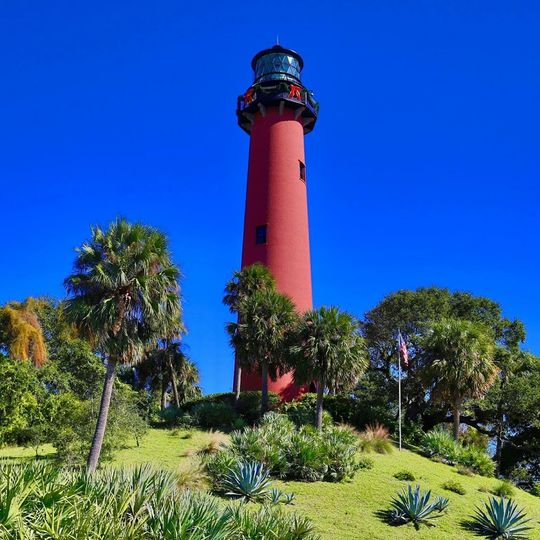
Jupiter Inlet Light, Historic lighthouse in Jupiter, United States
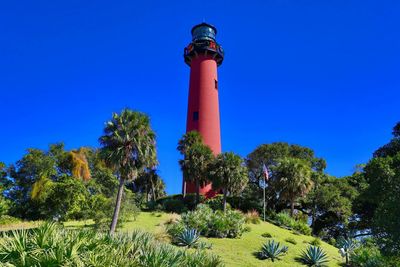
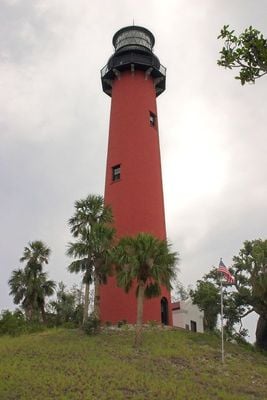
Jupiter Inlet Light is a 32-meter brick tower with double masonry walls: the outer wall tapers from eight bricks thick at ground level to three at the lantern base, while the inner wall is cylindrical and two bricks thick. The tower is painted red, with a black multi-sided lantern room and domed roof ringed by a gallery railing. Two small rectangular windows are set into the red surface.
The site was chosen in 1853 and the tower designed by Lieutenant George G. Meade, then modified with double masonry walls by Lieutenant William Raynolds. Silting of the inlet in 1854 forced supplies to be shipped in light boats down the Indian River, and the Third Seminole War halted work from 1856 to 1858. Captain Edward A. Yorke completed the brick tower in May 1860 and it was first lit on July 10, 1860, at a cost of more than $60,000.
The site at the junction of the Indian River and Jupiter Inlet was a meeting place for ancient Indian tribes for thousands of years before the tower was built. The grounds later held a Weather Bureau and signal station from 1889, where passing ships were signalled by semaphore flags by day and flares at night. The Loxahatchee River Historical Society, founded in 1972, runs the museum beside the tower.
The site is open to visitors on weekdays and weekends, with guided tours available throughout the day. There is a minimum height requirement for climbing to the top of the tower, so check this requirement before your visit.
The light's flash pattern is two 0.1-second white flashes, separated by 7.7 seconds, within a 30-second cycle; the second flash is followed by 22.1 seconds of darkness. Its focal plane sits 47 m above sea level and the beam reaches 25 nautical miles. The tower's red paint dates from 1910, applied to hide humidity stains.
The community of curious travelers
AroundUs brings together thousands of curated places, local tips, and hidden gems, enriched daily by 93,895 contributors worldwide.