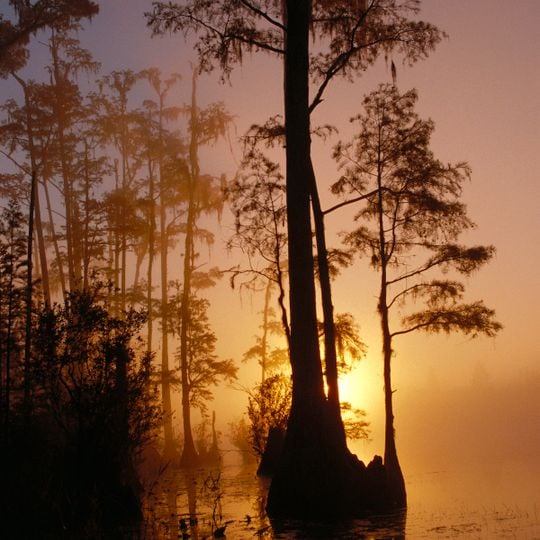
Okefenokee National Wildlife Refuge, Wildlife refuge in Baker County, United States.
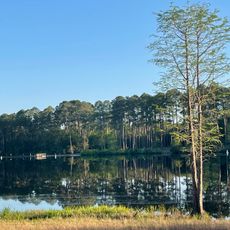
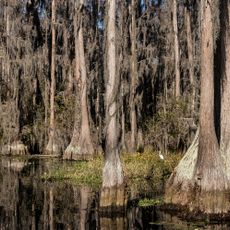
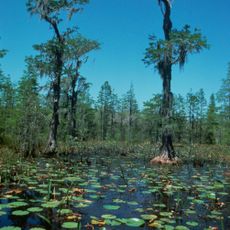
The Okefenokee National Wildlife Refuge protects about 402,000 acres of the Okefenokee Swamp, a peat-filled bog in a saucer-shaped depression once part of the ocean floor, lying 103 to 128 feet above sea level. Its habitats are open wet prairies, cypress forests, scrub-shrub stands, upland islands and open lakes. Tannic acid from decaying plants tints the slow water tea-colored; the Suwannee and St. Mary's rivers rise here.
Native Americans lived in the Okefenokee from as early as 2500 BC, including the Deptford, Swift Creek and Weeden Island cultures; the Seminoles were the last tribe to take refuge there. In 1891 the Suwannee Canal Company bought 238,120 acres to drain the swamp for plantations, then turned to logging. President Franklin D. Roosevelt established the refuge by Executive Order 7593 in 1937.
The name "Okefenokee" is usually translated as "land of trembling earth" and probably comes from Hitchiti oki fanôːki, "bubbling water". The swamp holds traces of the Deptford, Swift Creek and Weeden Island cultures, and the Seminoles were the last tribe to take refuge here. Visitors today see cypress forests and tea-coloured water darkened by tannic acid from decaying plants.
Visitors can enter the refuge through three main access points where paddling opportunities span about 121 miles of water routes. Fishing and wildlife watching are possible year-round, though cooler months offer the most comfortable conditions.
Peat deposits up to 15 feet thick cover much of the swamp floor, and in places they are unstable enough that trees and bushes tremble when the surface is stomped. This is the origin of the name Okefenokee, from Hitchiti oki fanôːki, "bubbling water".
The community of curious travelers
AroundUs brings together thousands of curated places, local tips, and hidden gems, enriched daily by 92,632 contributors worldwide.