Orange Hall, Greek Revival residence in St. Marys, United States.
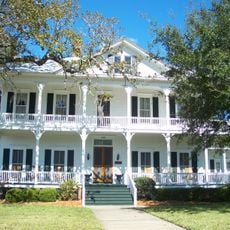
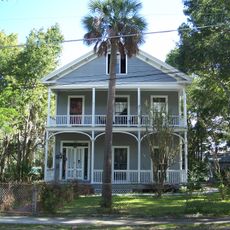
Orange Hall is a two-story residence with four tall columns supporting a triangular gable and symmetrical windows across its white exterior. The interior contains original furnishings and displays crafted details such as interior chimneys and period staircases from when it was built.
The lot was granted to William Ashley, a founder of St. Marys, in 1787; the northern half was sold in 1826 to John Wood and Presbyterian minister Horace Southworth Pratt. Pratt's wife Jane died in 1829, and the house was completed in 1838 by master carpenter Isaac Slayton. Pratt left for the University of Alabama in 1839 and died in 1840. It was listed on the National Register of Historic Places on May 7, 1973.
The name comes from the orange trees that once surrounded the house. In the basement, the old kitchen keeps whitewashed walls, a herringbone brick floor and a Dutch oven; the former dining room lay beneath the front portico. From 1961 the city used the building as a library under the name Gilman Civic Center.
Orange Hall stands at 311 Osborne Street inside the St. Marys Historic District; the sources record no regular opening hours or guided tours, so check with the city before planning a visit. The basement storey is stuccoed with inch-projecting quoins, and its old kitchen keeps whitewashed walls, a herringbone brick floor and a Dutch oven.
During the early 1980s, a Navy Reserve unit worked to restore the building when it faced deterioration and potential loss. This unusual partnership between military service members and local preservation efforts shows how different groups can work together to save history.
The community of curious travelers
AroundUs brings together thousands of curated places, local tips, and hidden gems, enriched daily by 93,898 contributors worldwide.