Fort San Carlos, Spanish wooden fort in Fernandina, United States
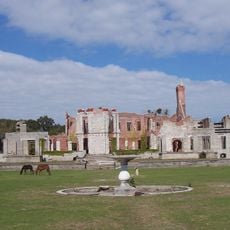
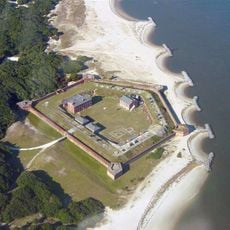
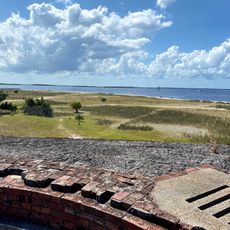
Fort San Carlos was a lunette fortification built in 1816 on a bluff above the Amelia River, on the southwest edge of Fernandina. It consisted of wood and earthworks backed by a wooden palisade on the east, with an eight- or ten-gun battery and two blockhouses guarding the southern land approach. The structure has disappeared; only traces remain within Fernandina Plaza Historic State Park.
Fort San Carlos was built around 1816 on the bluff above the Amelia River, replacing a small wooden battery of three cannon used from 1801 to 1814. It mounted four long Spanish 16-pounders, five 4-pounders and one 6-pound carronade, guarding the harbor and the St. Marys River channel. The fort has disappeared; only traces remain in Fernandina Plaza Historic State Park.
The fort's name and street grid come from Spanish colonial rule: in 1811 Governor Juan José Estrada had surveyor George J. F. Clarke lay out Fernandina under the 1542 Laws of the Indies, with the fort and parade ground facing Calle de Estrada. The site also overlays a Timuqua village where a Spanish sentinel house stood in 1696.
The site is best explored on foot since the remains are scattered across the northern tip of Amelia Island near the historic downtown area. Visitors should expect to see mostly foundations and earthwork ridges rather than standing structures, as much of the original fort has eroded over time.
Archaeology starting in the early 1950s found intermittent occupation of the site stretching back some 4,000 years, from the Orange period (2000–500 BC) onward. A Spanish sentinel house was built in 1696 at the Timuqua village there, and nearly all of Old Town was later built over that village and its shell heaps.
The community of curious travelers
AroundUs brings together thousands of curated places, local tips, and hidden gems, enriched daily by 92,761 contributors worldwide.