Savannah Victorian Historic District, Historic district in Savannah, United States.
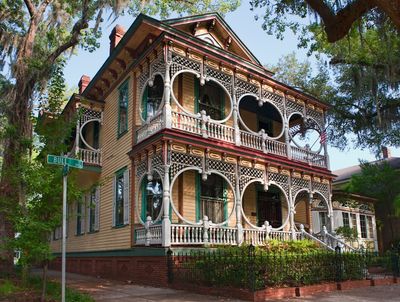
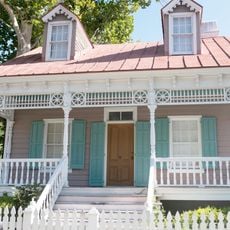
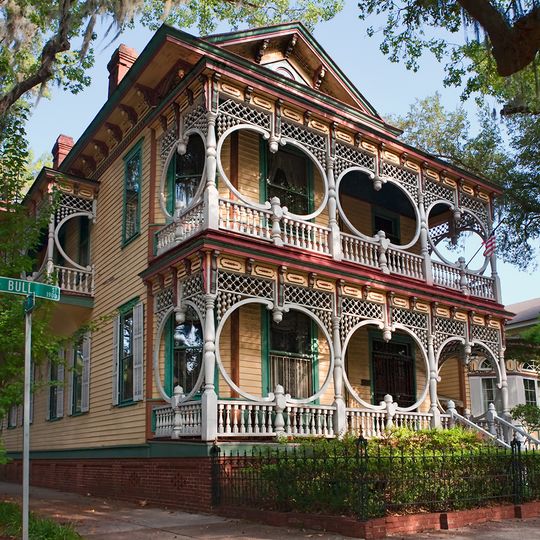
The Savannah Victorian Historic District is a mostly residential area of Late Victorian and Queen Anne buildings laid out on a modified grid. Its 45-block original section, bordered by Gwinnett, Price, Anderson and Montgomery Streets, was extended in 1982 toward Abercorn and 31st Streets. Houses such as the two-story frame example with pale yellow siding, a dark red brick base and stacked porches with white latticework show the district's wooden construction.
The district was developed mainly between 1870 and 1910 as Savannah's first streetcar suburb, laid out on a modified grid that departed from James Oglethorpe's ward-and-square plan. Before that, the southwestern portion held Cantonment Oglethorpe, a U.S. Army artillery installation operating from 1826 to 1835; the site was ceded to the city in 1853 and now forms part of Forsyth Park and Lloyd Ward.
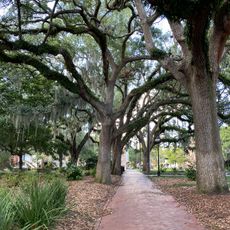
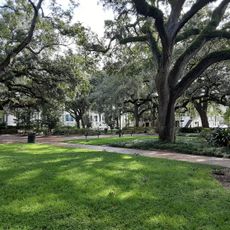
The neighborhood displays a grid pattern layout instead of the traditional square design found elsewhere in the city, with green spaces tucked between sidewalks and streets. This arrangement created a distinct character and continues to shape how residents experience daily life here.
The original 1974 district covers 45 blocks bounded by Gwinnett, Price, Anderson and Montgomery Streets; the 1982 extension adds the area between Gwinnett, Abercorn and 31st Streets. The district lies south of the Savannah Historic District and is reached on foot from Forsyth Park.
The district was laid out as Savannah's first streetcar suburb, developed mainly between 1870 and 1910 on a modified grid that departed from James Oglethorpe's ward-and-square plan. Before that, its southwestern portion held Cantonment Oglethorpe, a U.S. Army artillery installation operating from 1826 to 1835 and ceded to the city in 1853.
The community of curious travelers
AroundUs brings together thousands of curated places, local tips, and hidden gems, enriched daily by 93,259 contributors worldwide.