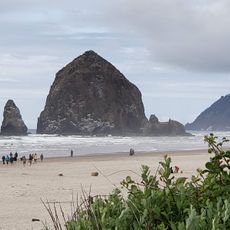
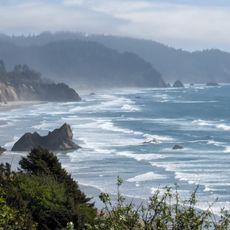
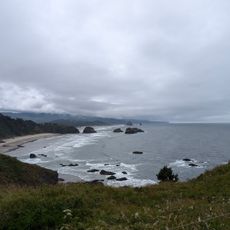
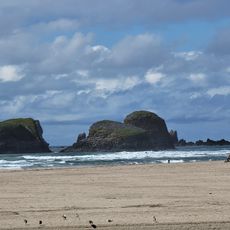
Haystack Rock, Basalt sea stack in Cannon Beach, Oregon.
Haystack Rock is a basalt sea stack rising about 72 meters (235 feet) above the water off the shore of Cannon Beach in Oregon. At low tide, shallow pools appear between the rocks where crabs, starfish, and other marine residents live among barnacles and seaweed.
Haystack Rock formed 15 to 17 million years ago from basalt lava flows linked to the Yellowstone volcanic hotspot. Erosion later cut the monolith off from the coastline. In 1968 a protruding ledge used by illegal climbers was blasted off, and in 1990 the Oregon Department of Fish and Wildlife granted it Marine Garden status. It is now protected within the Oregon Islands National Wildlife Refuge.
The formation draws birdwatchers and naturalists who wade through tide pools at low tide to observe starfish and anemones up close. Rangers and volunteers often stand on the beach to answer questions and explain marine creatures and protected nesting zones to visitors.
Low tide is the best time to visit because you can walk closer to the formation and see the creatures in the pools. Waterproof shoes help when walking over slippery rocks, and visitors should watch for the returning tide to avoid being cut off.
Three smaller adjacent rock formations south of Haystack Rock are called "The Needles". In 1968, a protrusion used as a ledge by illegal climbers was blasted off the rock. Climbing above the mean high tide barnacle line is prohibited to protect nesting birds.
The community of curious travelers
AroundUs brings together thousands of curated places, local tips, and hidden gems, enriched daily by 92,683 contributors worldwide.