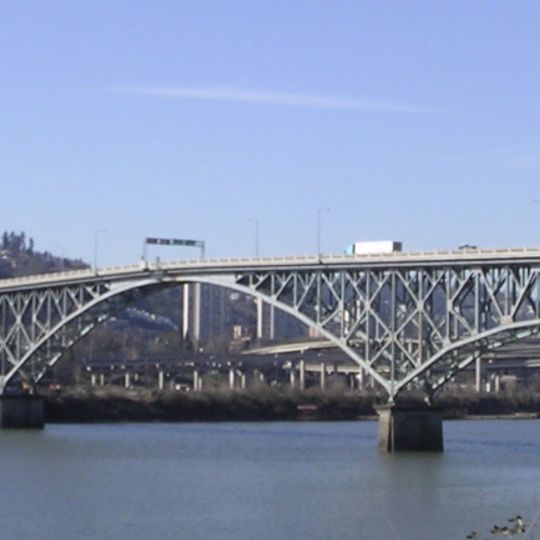
Ross Island Bridge, Cantilever bridge in Portland, United States
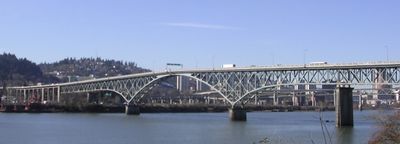
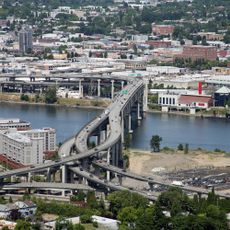
Ross Island Bridge is a cantilever deck truss bridge of steel carrying U.S. Route 26 across the Willamette River between southwest and southeast Portland. Its main span over the river is about 554 meters long with a maximum span of 163 meters, and the total length with approaches is 1,130 meters. The deck rises 37.5 meters above the water, and the bridge is 15.85 meters wide.
The bridge was built in 1925–1926 as part of a Portland bridge programme that also produced the Burnside and Sellwood bridges, after a first concrete arch design was dropped. The Brno-born engineer Gustav Lindenthal designed the steel cantilever truss, and Multnomah County owned it until 1976, when it passed to the Oregon Department of Transportation. It opened on 21 December 1926.
The bridge is named for its proximity to Ross Island, about 800 feet (240 m) south, which was settled by Oregon pioneer Sherry Ross. The bridge does not touch or provide access to the island. The name is a reference point rather than a link: the crossing lands in southeast Portland, and the island stays out of reach below.
The walkway runs along the north side of the bridge, with no barrier between the sidewalk and the westbound right lane, so walkers share the edge with traffic. It continues west toward Kelly Avenue and Porter Street and east as the north sidewalk of Powell Boulevard. About 50,600 vehicles crossed daily as of 2014.
The bridge's 1965 blue paint was not its first color: the steel girders were black until a 1955–56 repainting in green. Architect Lewis Crutcher's 1961 proposal to give Portland's downtown bridges different colors led to the phthalo blue seen today, restored in a repainting completed in early 2019.
The community of curious travelers
AroundUs brings together thousands of curated places, local tips, and hidden gems, enriched daily by 93,804 contributors worldwide.