Sugar House Monument, Art Deco monument in Sugar House district, Salt Lake City, United States.
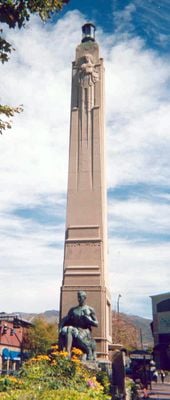
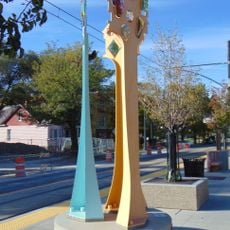
The Sugar House Monument is a 50-foot shaft topped with Art Deco styling in the center of the Sugar House neighborhood with two large figures positioned at its base. The structure features detailed stone carvings and relief scenes that depict industrial heritage and scenes of early regional activity.
In 1855 Mormon settlers built a mill in Sugar House to refine sugar from beets, but the process failed and Brigham Young shut it down that summer. The building later served as a paper factory, a bucket factory and a Utah Central Railroad machine shop until 1928. Sculptor Millard F. Malin proposed a monument to early manufacturing; the city and the Sugar House Business Men's League funded the $2,000 work, dedicated on November 11, 1934, about 200 feet east of the mill site.
The carved scenes on the monument show local Native American life and early trading activities that took place in this area. These visual stories help visitors understand how the region was inhabited and used before modern development.
The monument is located at the intersection of 1100 East and 2100 South, making it easy to find and use as a navigation landmark in the neighborhood. The open setting allows you to walk around the structure and view it from multiple angles.
The two large figures at the base represent specific concepts through their placement: a female figure facing east symbolizes Salt Lake Valley while a male figure facing west has its own regional meaning. This opposing arrangement reflects the geographical and cultural importance these directions held for the region's early development.
The community of curious travelers
AroundUs brings together thousands of curated places, local tips, and hidden gems, enriched daily by 93,138 contributors worldwide.