Lindenmeier Site, Archaeological site in Larimer County, US.
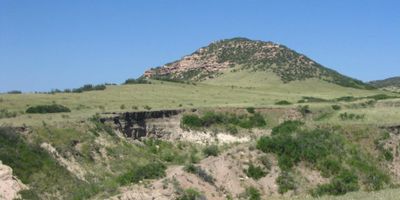
Lindenmeier Site is a stratified archaeological site on the east flank of the Rocky Mountains in Larimer County, Colorado, about 40 km north of Fort Collins. Its exposed cut bank shows dark brown, blocky earth at one end and lighter tan and gray bands of harder rock and softer soil at the other, topped by low green shrubs, with a slope of loose dirt and rock fragments below.
Excavations conducted between 1934 and 1940 by Frank Roberts from the Smithsonian Institution revealed human occupation dating back roughly 11,000 years. This research established the site as a key location for understanding early North American populations.
The site is named after William Lindenmeier, Jr., the rancher who owned the land when it was discovered in 1924. The Folsom points found here were identified by E. B. Renaud of the University of Denver in 1926, after comparison with the Folsom site in New Mexico. The artifacts include round polished discs with indented rims, the oldest form of Paleo-Indian artwork found in Colorado.
The site lies in Soapstone Prairie Natural Area, about 40 km north of Fort Collins, on the east flank of the Rocky Mountains. The terrain is flat prairie; stay on marked paths to avoid disturbing excavation areas. The exposed cut bank shows layered soil and rock.
Archaeologists discovered a bison vertebra with a spear point lodged inside it, providing direct evidence of how early hunters used their weapons. This find is one of the rare physical confirmations of hunting practices from that ancient period.
The community of curious travelers
AroundUs brings together thousands of curated places, local tips, and hidden gems, enriched daily by 94,452 contributors worldwide.