Boise River and Canal Bridge, bridge in United States of America
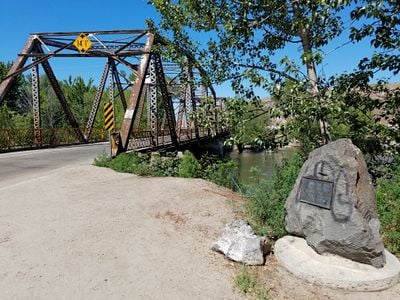
The Boise River and Canal Bridge is a historic bridge in Caldwell, Idaho that crosses the Boise River. It has three sections supporting one lane of traffic, a roadway width of about 19.5 feet (6 meters), and a clearance height of roughly 14 feet (4 meters), making it unsuitable for large vehicles.
The bridge was built in 1922 by the American Bridge Company and designed by city engineer Fred H. McConnel. It stands on a site where Oregon Trail travelers once forded the Boise River, and it was added to the National Register of Historic Places in 2007.
The bridge was commissioned by Canyon County officials under the name Canyon Hill Bridge, replacing an earlier crossing of that name. It later appeared on maps and signs as the Idaho Pacific Highway Bridge, the Highway 30 Bridge and the Silver Bridge, following the routes it carried.
The roadway is 19.5 ft (5.9 m) wide, so only one vehicle passes at a time, and vertical clearance is 14.1 ft (4.3 m). Canyon County officials have discussed refurbishing the span for pedestrians and bicycles while building a new bridge for motorized traffic nearby.
The bridge was built using a Warren camelback through-truss design, a sophisticated construction technique where angled metal pieces distribute weight. Today, Canyon County officials are discussing converting it into a pedestrians-only and bicycle bridge while a new crossing for vehicles might be built nearby.
The community of curious travelers
AroundUs brings together thousands of curated places, local tips, and hidden gems, enriched daily by 94,467 contributors worldwide.