Black Butte Crater Lava Field, Volcanic formation in Lincoln County, Idaho, United States.
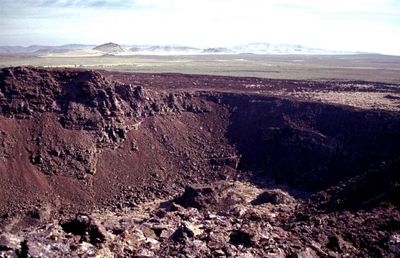
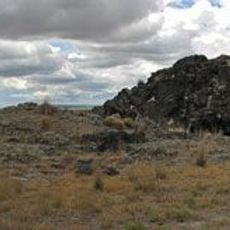
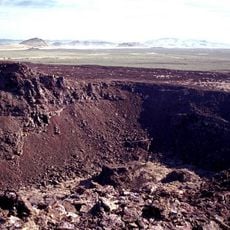
Black Butte Crater Lava Field is a volcanic formation dominated by a central crater with walls reaching up to 30 meters high on the northeast edge. The surrounding terrain consists of hardened basalt flows that create a rough, wave-like surface across the entire area.
The lava field formed during an eruption of the Shoshone Volcano, a stratovolcano, around 8100 BC ± 350 years. Lava flowed mainly through the original valley of the Big Wood River, filling it and following its bend to the west, which gave the field its L-shaped course. The Big Wood later cut through the northern end, while the Little Wood was diverted along the southern flank, so the two rivers now meet 40 kilometers west of their former confluence.
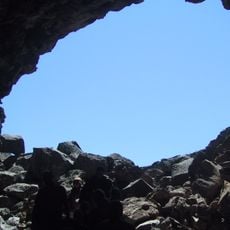
The field's earlier name, Shoshone Lava Field, comes from the city of Shoshone just south of the flow. The Shoshone Ice Caves, a section of lava tubes southeast of Black Butte, stay cold enough that ice remains frozen through summer.
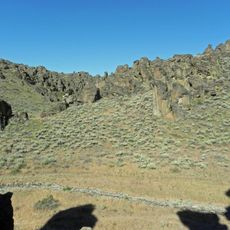
Wear sturdy shoes with good grip when visiting, as the ground is covered with sharp basalt fragments that can easily injure unprotected feet. Move carefully and deliberately across the rough terrain to avoid slips and injuries from the jagged surface.
The 1,550-metre Black Butte in the north-east of the field is the original vent of the Shoshone volcano; the floor of its nested craters is a solidified lava lake of about 2.2 km², with crater walls rising up to 30 metres. Part of the lava-tube system to the south-east forms the Shoshone Ice Caves, where ice stays frozen through summer.
The community of curious travelers
AroundUs brings together thousands of curated places, local tips, and hidden gems, enriched daily by 94,362 contributors worldwide.