Wilson Butte Cave, Archaeological site in Snake River Plain, Idaho.
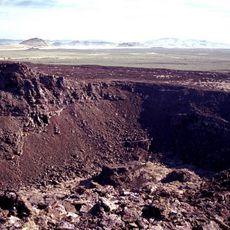
Wilson Butte Cave is an inflationary cave inside a rounded lava pressure ridge that rises from a flat bed of dark gray to black fine-grained basalt on the Snake River Plain. The cave is a lava tube developed within the ridge, about half a mile northwest of Wilson's Butte, the lava source.
Amateur explorers found the cave deposits undisturbed in 1958. Ruth Gruhn led excavations in 1959–1960 and 1988–1989; she dates the earliest occupation to 14,000–15,000 years ago. Artifacts from the cave are the oldest evidence of human presence on the Snake River Plain.
The cave was a base for hunting bison, and archaeologists have found strong connections between the Fremont culture and the Shoshone people, who lived there after the Fremont. The site is on the National Register of Historic Places and is maintained by the Bureau of Land Management.
Access is via Hunt Road northeast of Twin Falls and is available year-round, though winter weather can make vehicle access challenging. Visitors should prepare for uneven terrain and be ready for difficult conditions during bad weather.
A camel bone bearing tool marks was found in a lava tube at the site; radiocarbon dating placed it at more than 15,000 years old, older than the lava of the cave itself. It is the find that dates human working of the bone, and it shows camels once ranged across the Snake River Plain.
The community of curious travelers
AroundUs brings together thousands of curated places, local tips, and hidden gems, enriched daily by 93,255 contributors worldwide.