Twin Falls, Natural waterfall in Southern Idaho, United States.
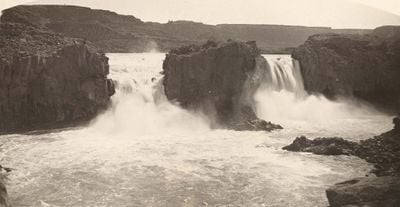
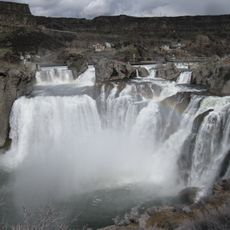
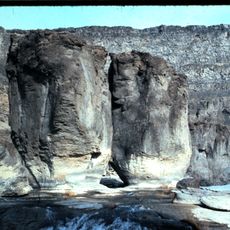
Twin Falls is a waterfall on the Snake River in southern Idaho, where water flows over a broad ledge and drops in a single sheet against a cliff of pale gray and tan blocky basalt. The Twin Falls Dam, built in the 1930s, now controls the flow; originally two parallel falls existed, but the dam diverted the southern fall, leaving only the northern one.
The falls lie on the Snake River just downstream from Milner Dam and upstream of Pillar Falls and Shoshone Falls. The Twin Falls Dam, built in the 1930s for irrigation and hydroelectric power, permanently diverted the southern of the two original falls, leaving a single waterfall. Before the dam, very high flows could create a smaller third fall to the south.
The falls gave their name to the nearby city of Twin Falls, a few miles to the west. The Danish source records a drop of 61 metres. The site lies on the border of Twin Falls and Jerome counties, just downstream from Milner Dam.
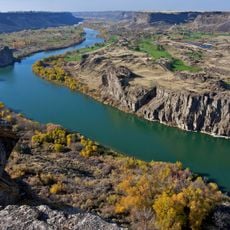
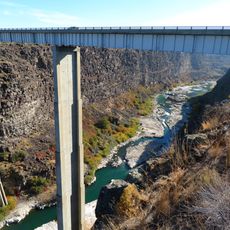
The falls are viewed from the rim of the canyon, where paved paths and open overlooks make it easy to get a clear view without climbing down. Visiting on a weekday or in the morning helps avoid crowds, especially during summer.
Despite having two falls in its name, only one is usually visible today because much of the river's water is diverted for irrigation upstream. Both falls can be seen at the same time only when the river runs unusually high, typically in spring.
The community of curious travelers
AroundUs brings together thousands of curated places, local tips, and hidden gems, enriched daily by 93,180 contributors worldwide.