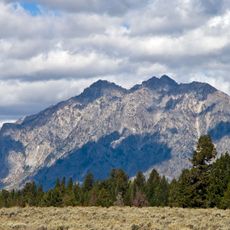
Mount Moran, Mountain summit in Grand Teton National Park, Wyoming, US.
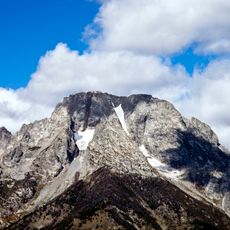
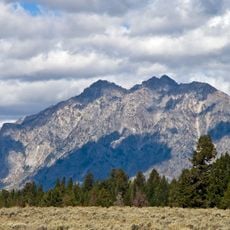
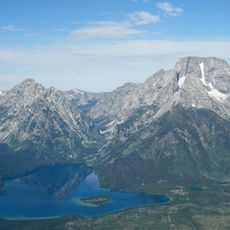
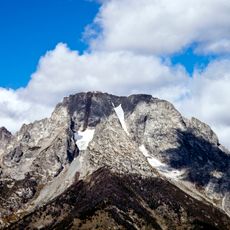
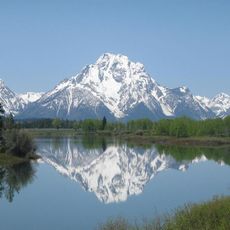
Mount Moran is a mountain in Grand Teton National Park, Wyoming, reaching 12,610 feet (3,840 m). Its east face rises about 6,000 feet (1,800 m) above Jackson Lake and carries the Black Dike, a dark basalt intrusion. Skillet Glacier is plainly visible on that same monolithic wall, alongside Falling Ice Glacier and the Triple Glaciers.
Mount Moran was named for the painter Thomas Moran, who joined the Hayden expedition of 1871–72 and whose landscapes helped bring about the founding of Yellowstone National Park in 1872. The first ascent came on July 22, 1922, when LeGrand Hardy, Bennet McNulty and Ben C. Rich of the Chicago Mountaineering Club climbed the Skillet Glacier route. On 21 November 1950 a New Tribes Mission DC-3C struck the mountain in fog at about 3,414 m, killing all 21 on board; the wreckage remains and the Park Service discourages visits.
The mountain takes its name from Thomas Moran, an American artist who painted landscapes of this region in the 1800s and helped bring the area to public attention. His name reminds visitors of the artists who first shared this landscape with the wider world.
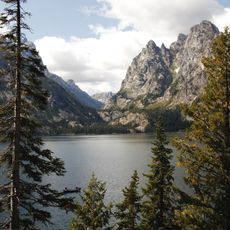
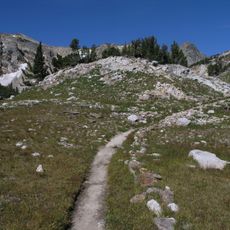
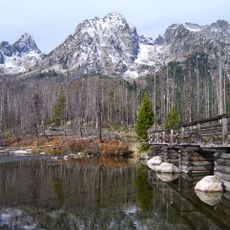
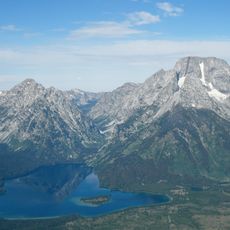
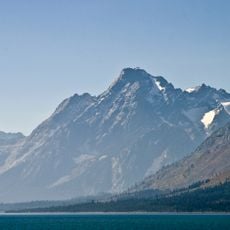
The best way to see the peak is from the lakes below or nearby hiking trails, as the summit itself is difficult to access. From a canoe or boat, you can get closer views and enjoy different perspectives of the mountain.
A black mineral vein runs through the mountain, created roughly one billion years ago when molten rock filled cracks in the earth's crust. This dark stripe is one of the most striking features when viewing the peak from different angles.
The community of curious travelers
AroundUs brings together thousands of curated places, local tips, and hidden gems, enriched daily by 92,704 contributors worldwide.