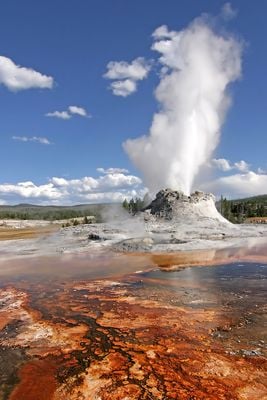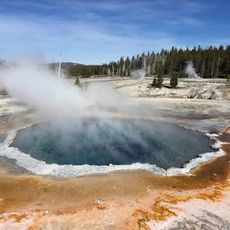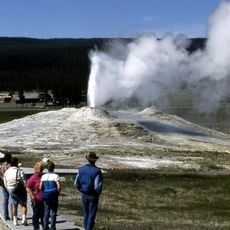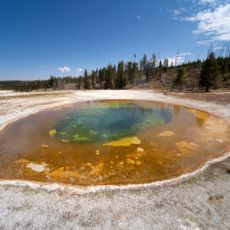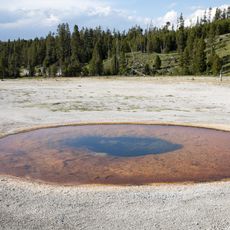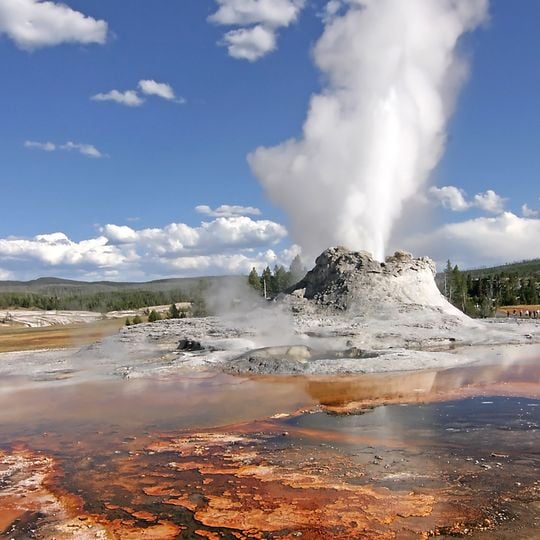
Castle Geyser, Cone geyser in Upper Geyser Basin, Yellowstone National Park, United States
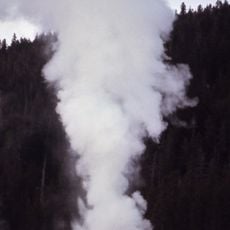
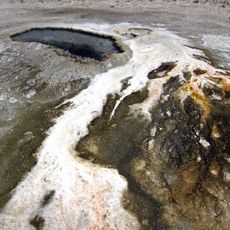
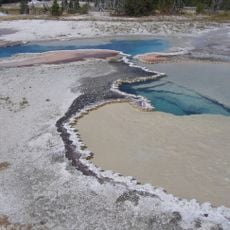
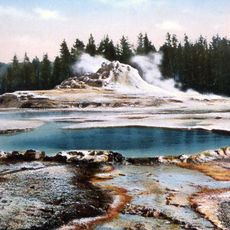
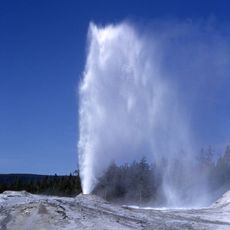
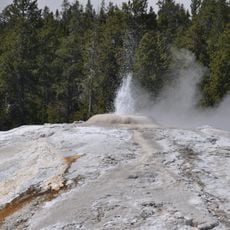
Castle Geyser is a cone geyser in the Upper Geyser Basin of Yellowstone National Park, built from grey and white geyserite sinter deposits that form a tall, terraced cone likened to a castle. Its eruptions send a vertical column of water about 27 m high for roughly 20 minutes, followed by 30 to 40 minutes of noisy steam.
Castle Geyser's cone was dated to around 1022 using carbon-14 dating, far younger than the earlier estimate of 5,000 to 15,000 years. On September 18, 1870, the Washburn-Langford-Doane Expedition entered the Upper Geyser Basin, and Lieutenant Gustavus Cheyney Doane named the geyser for its castle-like cone. A 3-D laser scan shows the cone evolved through four to five stages.
The name comes from the geyser's resemblance to a castle tower, a connection visitors can see in its distinctive mineral structure. This tower-like shape made it instantly recognizable when explorers first encountered it.
Visitors should allow time to watch eruptions from a safe viewing area and maintain distance from the hot activity around the cone. Early morning or late afternoon often provides quieter viewing conditions with fewer crowds in the basin.
A 3-D laser scan of the cone revealed that the geyser has evolved through four to five distinct stages to reach its present shape. The cone itself was dated to around 1022 using carbon-14 dating, far younger than the 5,000 to 15,000 years once assumed.
The community of curious travelers
AroundUs brings together thousands of curated places, local tips, and hidden gems, enriched daily by 92,651 contributors worldwide.