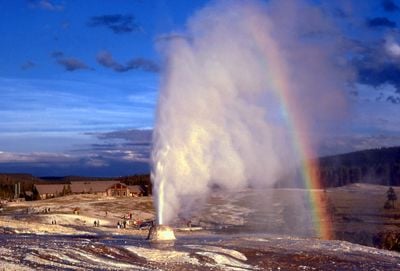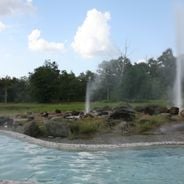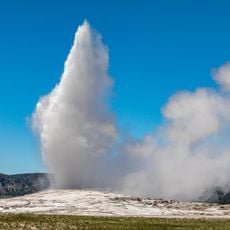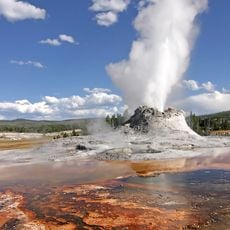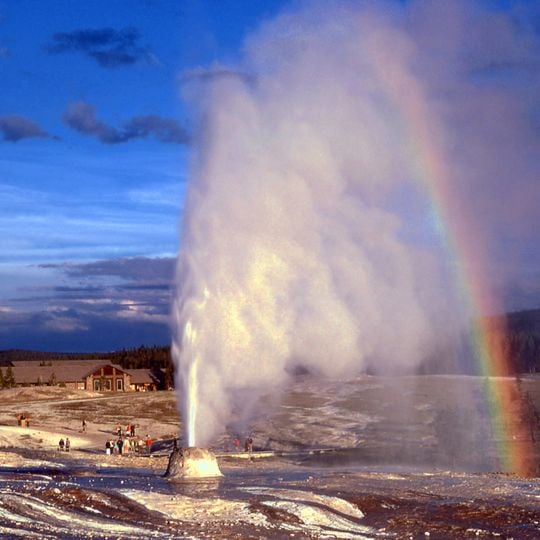
Beehive Geyser, Geyser in Upper Geyser Basin, Yellowstone National Park, US
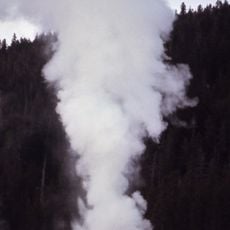
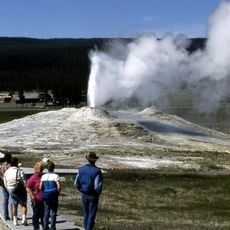
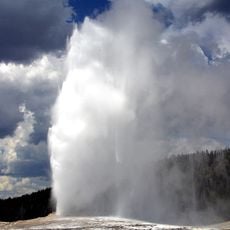
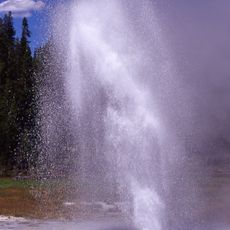
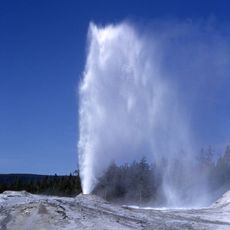
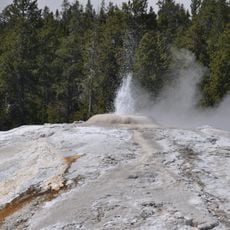
Beehive Geyser is a geyser in the Upper Geyser Basin of Yellowstone National Park. Its rough, pale grey cone rises about 4 feet (1.2 m) and resembles a straw beehive. Eruptions send a column of water and steam about 200 feet (61 m) straight up for roughly five minutes, often with a rainbow in the mist.
On September 18, 1870, the Washburn-Langford-Doane Expedition entered the Upper Geyser Basin and named seven erupting geysers, including this one. Nathaniel P. Langford described a siliceous cone three feet high and five feet across, with an oval orifice 24 by 36.5 inches; the party named it "The Beehive" after the cone's resemblance to a straw beehive.
The name comes from the Washburn-Langford-Doane Expedition of 1870, whose members thought the 1.2-metre cone looked like a straw beehive. Langford recorded an eruption of 219 feet lasting eighteen minutes. Visitors today watch for Beehive's Indicator, a small jagged cone about 3 metres away that usually plays 15 to 20 minutes before the main eruption.
Beehive's Indicator, a small jagged cone about 10 feet (3 m) away, usually starts playing 15 to 20 minutes before Beehive erupts, so watch it to time your wait. Eruptions last about 5 minutes and reach roughly 200 feet (61 m); intervals run from under 10 hours to over a day, and in summer 2009 they came every 11 to 14 hours. Beehive and its Indicator can also be watched on the Old Faithful webcam.
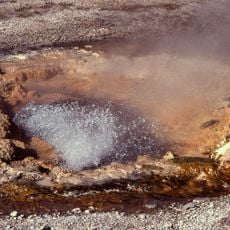
Beehive's Indicator, a jagged cone about 10 feet (3 m) from Beehive, usually plays 15 to 20 minutes before the main eruption, though Beehive can erupt without it. During a three-year dormancy in the 1990s, the Indicator erupted for up to 60 minutes with no Beehive eruption following.
The community of curious travelers
AroundUs brings together thousands of curated places, local tips, and hidden gems, enriched daily by 92,622 contributors worldwide.