Lone Star Geyser, Natural geyser in Yellowstone National Park, United States.
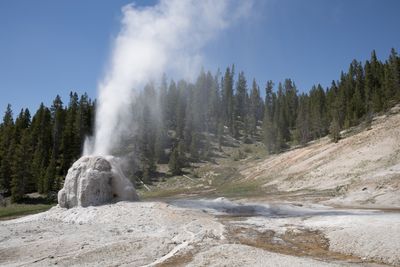
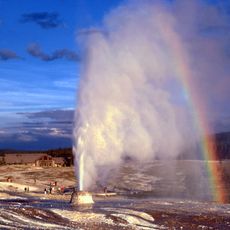
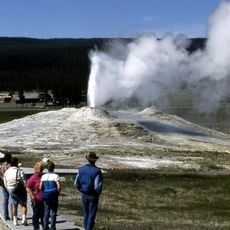
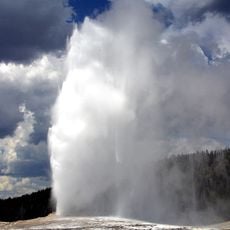
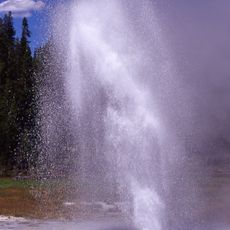
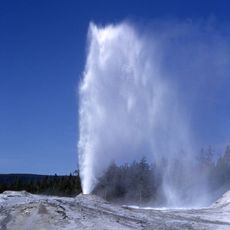
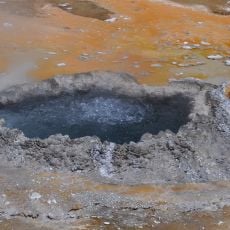
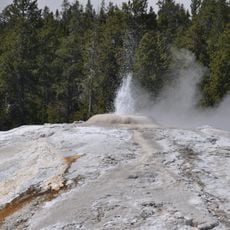
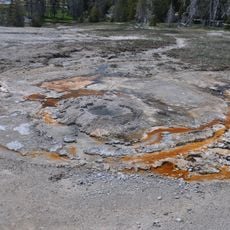
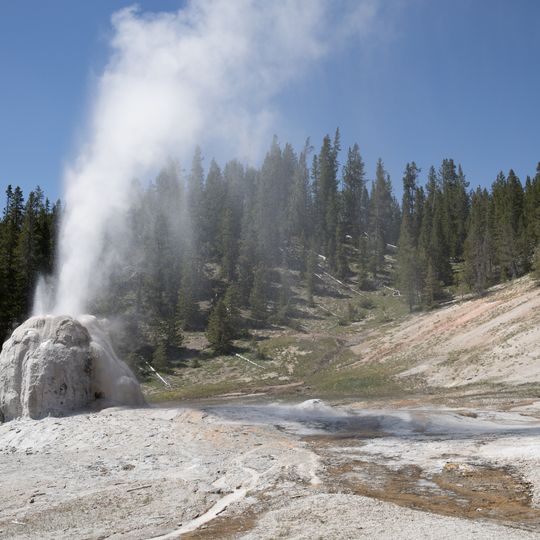
Lone Star Geyser is a cone geyser in the Lone Star Geyser Basin of Yellowstone National Park, Wyoming. Its rough, bulbous cone of pale gray and white mineral rock rises from flat, crusty ground and spreads outward at the base. Eruptions occur about every three hours, last roughly 30 minutes, and send a column of water and steam 35 to 40 feet (11 to 12 m) high.
Aubrey L. Haines, Yellowstone park historian from 1960 to 1969, recorded three accounts of the name. In 1882 two Northern Pacific Railway surveyors, believing their remote find undiscovered, wrote "Lone Star Geyser" in their notes; in 1879 hunters W. D. Pickett and J. M. V. Cochran used the name with photographer Henry Bird Calfee. The Hayden Geological Survey of 1872 had called it Solitary Geyser, a name later transferred to another geyser northeast of Old Faithful.
The geyser's name comes from three competing accounts recorded by park historian Aubrey L. Haines: Northern Pacific Railway surveyors in 1882, hunters W. D. Pickett and J. M. V. Cochran in 1879, and the Hayden Geological Survey of 1872, which called it Solitary Geyser before that name was reassigned to another geyser northeast of Old Faithful.
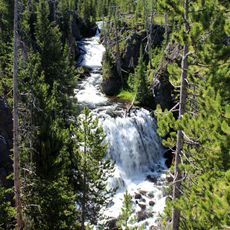
Lone Star Geyser sits 3 miles (4.8 km) southeast of Old Faithful, reached by an old service road open to hikers and cyclists; the trailhead is near Kepler Cascades on the Grand Loop Road. The route is flat and easy to follow, but can be muddy in spring or early summer.
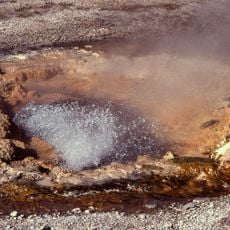
Each eruption begins with a long pre-play phase of hissing steam and small splashes before the main water column rises, which can last longer than the main burst itself. Arriving early enough to watch this build-up adds a different layer to the experience that many visitors miss by timing their arrival for the peak only.
The community of curious travelers
AroundUs brings together thousands of curated places, local tips, and hidden gems, enriched daily by 93,986 contributors worldwide.