Firehole Falls, Waterfall in Yellowstone National Park, US
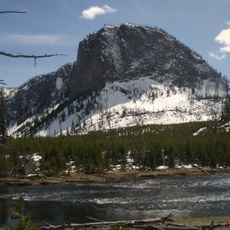
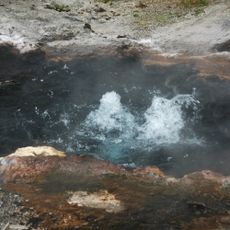
Firehole Falls is a waterfall on the Firehole River in southwestern Yellowstone National Park, about 0.5 miles (0.8 km) upstream of the Firehole's confluence with the Gibbon River at Madison Junction. It drops roughly 40 feet (12 m) within Firehole Canyon, where the channel narrows to about 150 feet between perpendicular volcanic rock walls. Firehole Canyon Drive, a one-way road, runs alongside it.
Lt. Gustavus C. Doane of the U.S. Army, a member of the Washburn-Langford-Doane Expedition, described the falls in his 1871 report to the Secretary of War, noting a fall of about 40 feet in a half mile where the channel narrows to 150 feet between perpendicular rocks. The Washburn and Hayden explorations also commented on the falls, but no record explains how they were named; by the mid-1880s government and commercial accounts routinely called them Firehole Falls.
The name Firehole Falls was in routine use by the mid-1880s in government and commercial accounts of the park, though no record explains its origin. The upper Firehole above the falls held no fish until brook trout were introduced in 1889; brown trout followed in 1890 in Nez Perce Creek and rainbow trout in the 1920s. The upper river is now a trout fishery, while the falls still stop spawning trout from the Madison River swimming up.
You can reach this spot via the one-way Firehole Canyon Drive, which branches off from the main road between Madison Junction and Old Faithful. The drive itself has several viewpoints along the river, making it easy to see the falls and surrounding rock formations.
The falls act as a natural barrier that stops trout from swimming upstream, creating distinct fish populations in different river sections. This geographic separation shaped two different ecosystems within the same waterway.
The community of curious travelers
AroundUs brings together thousands of curated places, local tips, and hidden gems, enriched daily by 92,779 contributors worldwide.