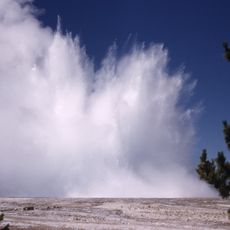
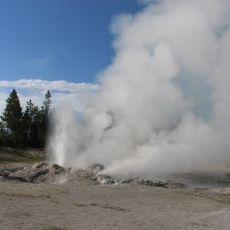
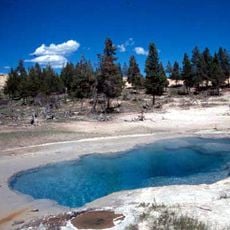
Gibbon Falls, Waterfall in Yellowstone National Park, US
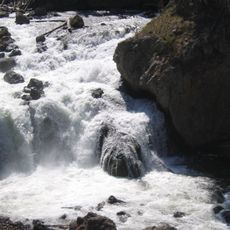
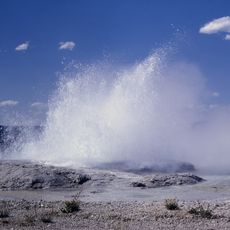
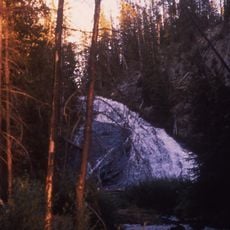
Gibbon Falls is a waterfall in Yellowstone National Park that drops about 84 feet over a steep rock face. The cascading water creates white spray that can be seen from several viewpoints along the walking trail.
The waterfall formed over rock structures created during a massive volcanic eruption that shaped the Yellowstone caldera roughly 631,000 years ago. These volcanic rocks continue to define the landscape and how water flows through the area today.
The name's origin is unrecorded, but government and commercial park accounts used "Gibbon Falls" routinely by the mid-1880s. In 1883 Henry J. Winser's tourist manual directed visitors to a steep trail on the right of the road, then four miles from the canyon entrance. The road itself ran on the opposite bank until 1895.
Access to the falls is through a short walking trail of about half a mile round trip from the parking area with viewing spots along the path. The best time to visit is in the morning when the light illuminates the mist and spray.
When the Washburn and Hayden surveys crossed the Gibbon basin in the 1870s, the river above the falls held no fish: the 84-foot drop blocked upstream migration. Rainbow trout were introduced above the falls in 1890, and in 1920 Arctic grayling from the Gibbon and Madison below the falls were stocked in Grebe Lake at the headwaters.
The community of curious travelers
AroundUs brings together thousands of curated places, local tips, and hidden gems, enriched daily by 94,049 contributors worldwide.