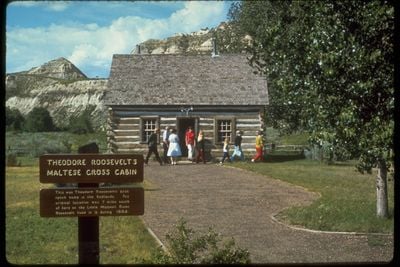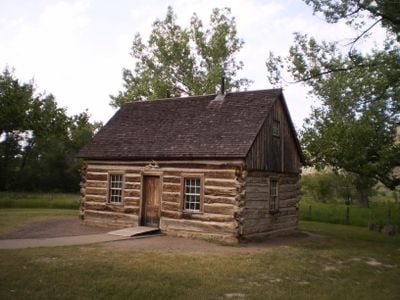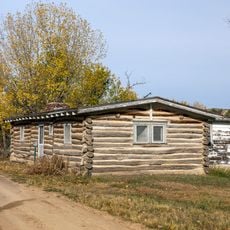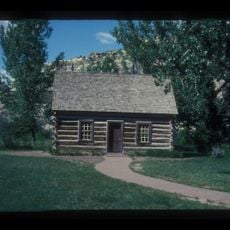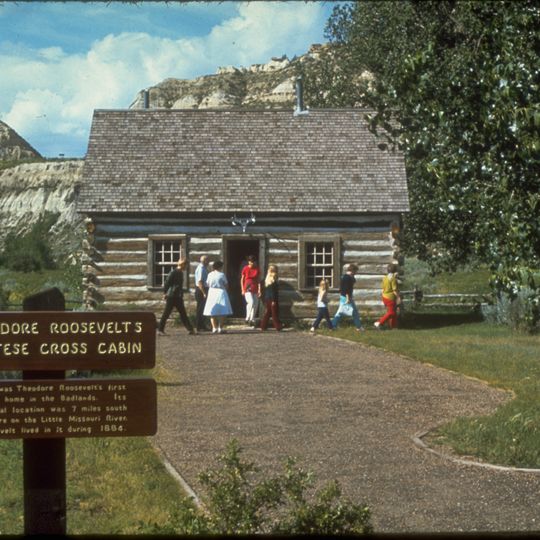
Theodore Roosevelt's Maltese Cross Cabin, Ranch cabin in Theodore Roosevelt National Park, North Dakota.
Theodore Roosevelt's Maltese Cross Cabin is a small structure made from ponderosa pine logs containing three rooms: a kitchen, a living area, and Roosevelt's personal sleeping quarters with wooden floors. The building now sits at the South Unit Visitor Center of Theodore Roosevelt National Park, restored to show how it looked during his ranching days.
Roosevelt first came to the Dakota badlands in 1883 to hunt a buffalo and soon acquired primary interests in the Maltese Cross (Chimney Butte) Ranch. He did not own acreage; like other ranchers, he squatted on public or Northern Pacific Railroad land. He used the cabin from 1883 to 1884, then left after his wife and mother died hours apart and built the Elkhorn Ranch.
Roosevelt arrived in the badlands in 1883 to hunt a buffalo and soon took a primary interest in the Maltese Cross, also called the Chimney Butte Ranch. He worked alongside ranch managers Sylvane Ferris and Bill Merrifield and the ranch hands, and later wrote that ranch life taught self-reliance, hardihood and the value of instant decision. The cabin's white hutch served as his bookcase and writing desk.
Guided tours of the cabin run from mid-June through Labor Day; outside that window the interior is self-guided. The cabin stands at the South Unit Visitor Center just outside Medora, and the original ranch site was about seven miles south of town in the Little Missouri bottomlands. A low wooden ramp leads to the plank door.
The cabin traveled to St. Louis, Missouri, for the 1904 World's Fair and later to Portland, Oregon, as part of the Lewis and Clark Centennial Exposition. These journeys made it a well-known attraction far from North Dakota before it eventually returned to its current home.
The community of curious travelers
AroundUs brings together thousands of curated places, local tips, and hidden gems, enriched daily by 92,632 contributors worldwide.