Himalayan subtropical pine forests, Subtropical pine forest ecoregion in the lower Himalayas, India
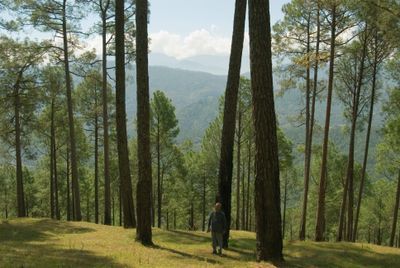
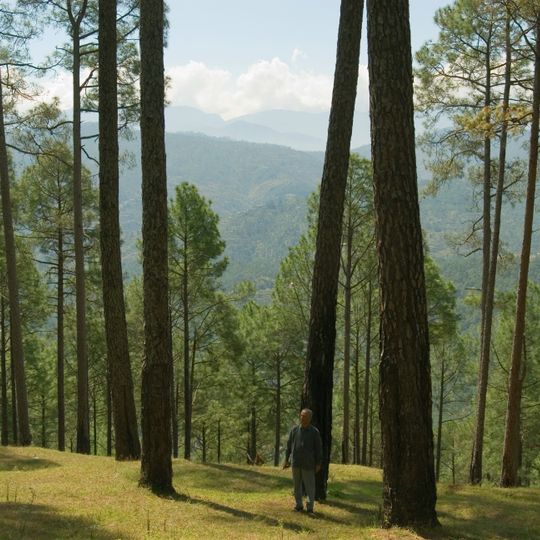
The Himalayan subtropical pine forests form a 3,000 km belt of drought-resistant Pinus roxburghii woodland along the lower Himalaya, from Pakistan's Punjab through Azad Kashmir, Jammu and Kashmir, Himachal Pradesh, Uttarakhand and Sikkim to Nepal and Bhutan. The trees rise from a thick grass layer of Arundinella setosa, cogon grass and Themeda anathera, with little shrub undergrowth because regular fires clear it. The forest grows mainly on south-facing slopes, between about 1,000 and 2,000 m in the Sivalik and Himachal ranges.
The ecoregion's pine cover is shaped by frequent fires, which prevent shrubby undergrowth from establishing and leave a ground cover of grasses such as Arundinella setosa, cogon grass and Themeda anathera. The forest is split by the deep Kali Gandaki Gorge in Nepal: west of it the woodland is drier, east of it wetter and thicker because monsoon rains from the Bay of Bengal bring more moisture. More than half the area has been cleared or degraded, most visibly in central and eastern Nepal, where it was cut for terrace farming.
The forest is shaped by fire: frequent fires prevent a shrub layer from forming, leaving thick grass of Arundinella setosa, cogon grass and Themeda anathera beneath the pines. In central and eastern Nepal, much of the pine has been cleared for terrace farming, so the woodland visitors walk through is often a working agricultural landscape.
The forest spans some 3,000 km along the lower Himalaya, from Pakistan's Punjab through Azad Kashmir, Jammu and Kashmir, Himachal Pradesh, Uttarakhand and Sikkim to Nepal and Bhutan. Stands grow mainly on south-facing slopes between 1,000 and 2,000 m, as in Kangra and Una districts of Himachal Pradesh. The deep Kali Gandaki Gorge in Nepal splits the ecoregion: drier to the west, wetter and thicker to the east.
The forest is split not by a ridge but by the deep Kali Gandaki Gorge in Nepal. West of the gorge the pine woodland is slightly drier; east of it, monsoon rain from the Bay of Bengal makes it wetter and thicker.
The community of curious travelers
AroundUs brings together thousands of curated places, local tips, and hidden gems, enriched daily by 92,946 contributors worldwide.