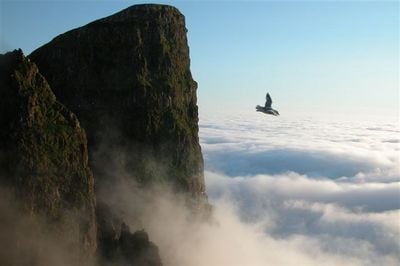
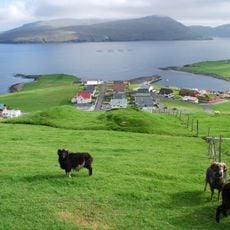
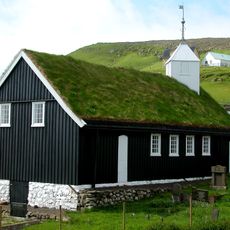
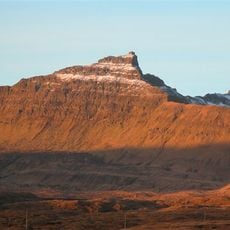
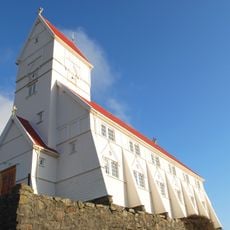
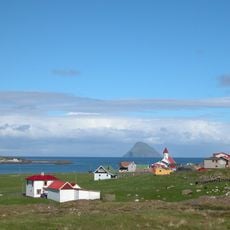
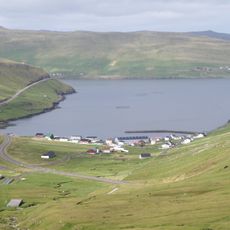
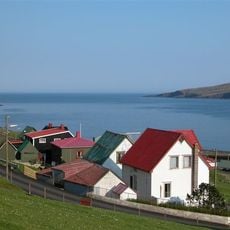
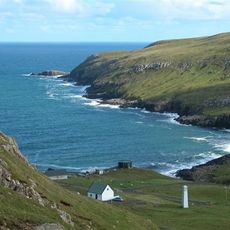
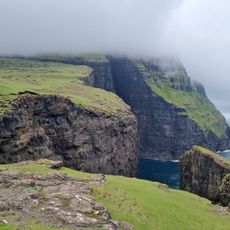
Beinisvørð, Sea cliff and summit in Suðuroy, Faroe Islands.
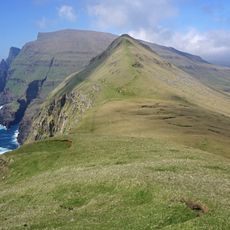
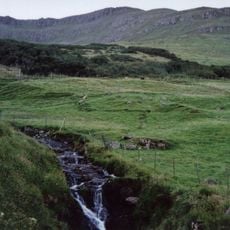
Beinisvørð is a sea cliff and mountain peak on the island of Suðuroy in the Faroe Islands that rises steeply about 469 meters above the Atlantic. It forms a distinctive triangular shape in the landscape between the villages of Lopra and Sumba.
Beinisvørð has long been a food source for the people of Sumba: men were lowered over the cliff edge on thick bird ropes, a practice called síging, to catch seabirds and collect eggs, and some died when stones fell on them. In 1975 a large landslide tore away many bird nesting sites and part of the original coastal formations. Poul F. Joensen (1898–1970) called the cliff the guardian spirit of the country, and Janus Djurhuus (1881–1948) used it as a symbol of Faroese independence in his poem about Nólsoyar Páll.
The cliffs were historically used for collecting seabird eggs, a dangerous practice that shaped how people lived and worked in this remote place. This tradition shows how closely residents depended on the natural resources around them.
Beinisvørð is best seen from Hesturin, on the one-lane road between Lopra and Sumba near the antenna; buses should reach Sumba first and turn at Hesturin, as the road toward Lopra has many curves. Another viewpoint is Lopranseiði, reached by turning right just before Lopra, less than a kilometre from the main road. A tunnel also links Lopra and Sumba.
Numerous seabirds still nest in the crevices and ledges of the cliff, offering visitors a chance to observe the rich birdlife of this region. The colonies are especially active and loud during breeding season.
The community of curious travelers
AroundUs brings together thousands of curated places, local tips, and hidden gems, enriched daily by 94,026 contributors worldwide.