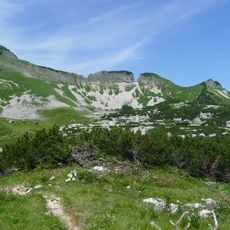
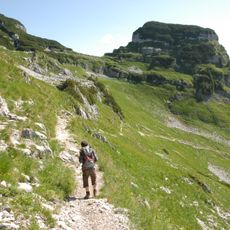
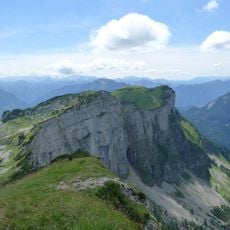
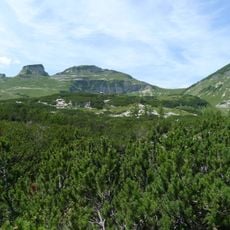
Schwarzmooskogel-Höhlensystem, Cave system in Altaussee, Austria.
The Schwarzmooskogel-Höhlensystem in the Totes Gebirge near Altaussee is a network of 17 individual caves, surveyed at 136,074 m long and 1,125 m deep as of August 2020, making it Austria's second-longest cave. Its Schneevulkanhalle, found in 1983, is about 130 m long, 90 m wide and up to 60 m high, with a roughly 50 m snow cone, 15 m ice stalagmites and ice stalactites up to 10 m long. Steinbrücken Cave (1623/204), discovered in 1999, is one of its parts.
The cave was first discovered in 1929, leading to systematic exploration starting in 1938. International expeditions, notably from Cambridge University, contributed significant findings from 1976 onward about the cave's structure.
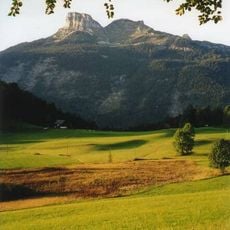
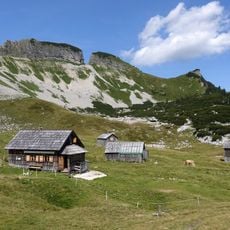
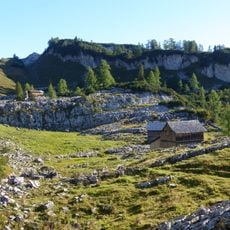
The system is closed to visitors and reserved for cave researchers. Its name comes from the Schwarzmooskogel massif above it, and the individual caves carry names given by exploring clubs: Steinbrücken Cave is named after a nearby natural arch, a former entrance to Traungold Cave that has been fitted out as a bivouac shelter for cavers.
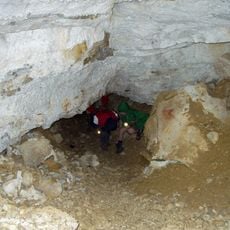
The system is accessible only to cave researchers; there is no tourist entry. Work is organised from the Loser Plateau above Altaussee, where the natural arch near Steinbrücken Cave serves as a bivouac shelter. Steinbrücken Cave alone has six entrances, and most explorations start at entrance E, which begins with an awkward crawl followed by a 30-metre pitch that usually holds snow at its base.
One of the more remarkable chambers contains a permanently frozen snow cone with multiple ice formations, representing a rare underground phenomenon. This icy structure maintains its shape throughout the year and reveals the special microclimatic conditions at that depth.
The community of curious travelers
AroundUs brings together thousands of curated places, local tips, and hidden gems, enriched daily by 94,050 contributors worldwide.