Hundertwasserhaus, Expressionist residential building in Landstrasse district, Vienna, Austria
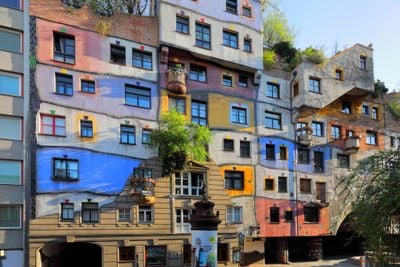
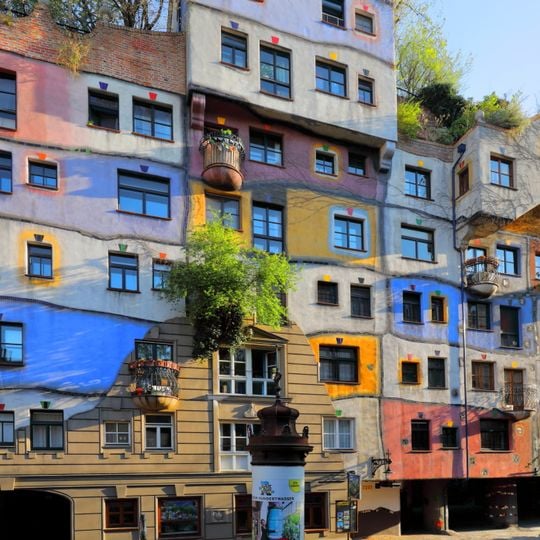
Hundertwasserhaus is a municipal apartment house at Kegelgasse 34–38 and Löwengasse 41–43 in the Landstraße district. Its undulating facade is divided into uneven patches of blue, yellow, white, grey, red and beige, with windows of varying sizes framed by coloured bands. Two rounded balconies with basket-like railings project from the facade, and a tree grows from an upper terrace.
Chancellor Bruno Kreisky proposed the project in a letter of 30 November 1977, and mayor Leopold Gratz invited Hundertwasser to design it on 15 December 1977. Built from 16 August 1983 to 15 October 1985 by the City of Vienna, it opened on 1 March 1986 at a cost of about six million euros. Hundertwasser took no fee, and in 2010 Austria's Supreme Court named Josef Krawina co-creator alongside him.
The name honors artist Friedensreich Hundertwasser, whose philosophy against straight lines shapes every detail visitors notice. Residents care for trees growing from individual windows, connecting daily life with plants.
The building itself remains private and cannot be entered, but the exterior can be viewed from the sidewalk. The neighboring Hundertwasser Village offers shops and a cafe in the same style and opens during daytime hours.
Each resident may paint the facade around their window as far as they can reach while leaning out with a brush in hand. This window right rule ensures the exterior keeps changing over the years.
The community of curious travelers
AroundUs brings together thousands of curated places, local tips, and hidden gems, enriched daily by 92,658 contributors worldwide.