Irrsee, Lake in Salzkammergut, Austria
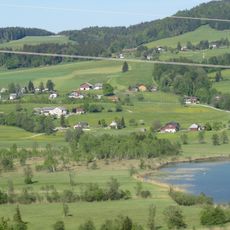
Irrsee is a freshwater lake in Upper Austria that features clear water and gently sloping shorelines bordered by green hills. The body of water has several coves and inlets with varying terrain along its perimeter.
Irrsee formed around 17,000 years ago at the end of the Würm glaciation, when the retreating Traungletscher left a tongue-shaped basin that filled with meltwater. Peat bogs and wet meadows at the north and south ends show the lake was once nearly twice as long. Today the entire water surface belongs to the municipality of Zell am Moos.
In 1999, the Mondsee Land Art project installed two works on the Irrsee shore: Benoît Tremsal's Gekippte Fläche at the bathing area in Zell am Moos, and Sjoerd Buisman's sculpture Phyllotaxis-Irrsee on a rise at the south shore, which depicts a cross-section of a celery stalk's leaf arrangement meant to echo the lake's outline.
The lake has several swimming areas easily accessible from the shoreline with parking at main entry points. Summer months offer the best conditions for water activities when the water temperature is most comfortable.
The lake's basin is split by a ridge lying 21 m deep into a smaller northern basin of 27 m and a larger southern one of 32 m. Because of its small volume and wind-sheltered position it regularly freezes over, with ice cover lasting from one week to two months.
The community of curious travelers
AroundUs brings together thousands of curated places, local tips, and hidden gems, enriched daily by 94,419 contributors worldwide.