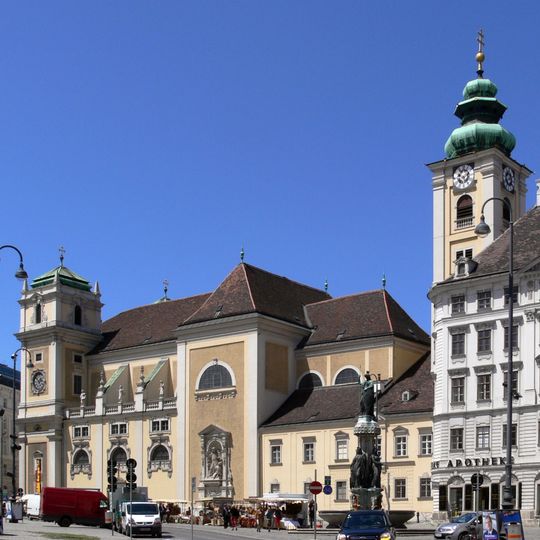
Schottenstift, Benedictine abbey in Innere Stadt, Austria
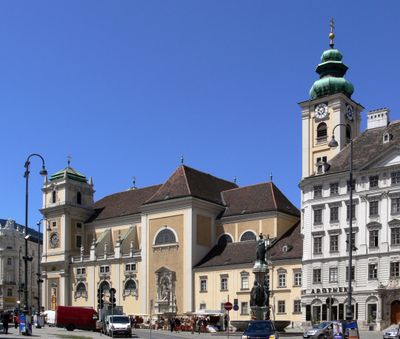
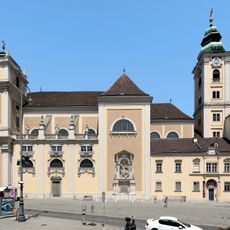
Schottenstift is a Benedictine abbey at Freyung 6 whose pale yellow Baroque facade carries a brown tiled roof, a large arched window with a sculpted relief panel below it, and pilasters. Green onion domes with clock faces rise on the left section and on the taller right tower. The church, rebuilt from 1638 by Andrea d'Allio the Younger and Silvestro Carlone, stands somewhat shortened, its Baroque west tower barely higher than the facade.
Henry II Jasomirgott moved his residence from Klosterneuburg to Vienna and in 1155 called Irish monks from the Scots Monastery of St. Jakob in Regensburg, stipulating in the foundation charter "Solos elegimus Scottos". The first church, begun in 1155 and consecrated in 1200, was a three-aisled Romanesque pillar church; Henry was buried there in 1177. In 1418 Duke Albert V replaced the Irish monks with German-speaking Benedictines under the Melker Reform, and a lightning strike in 1638 led to the Baroque rebuilding by Andrea d'Allio the Younger and Silvestro Carlone.
The abbey houses medieval religious artworks that reflect the monks' engagement with spiritual themes across centuries. These pieces, including the notable Schottenmeisteraltar, offer insight into how faith was expressed through visual art in the late medieval period.
The museum opens Thursday and Friday from 11 am to 5 pm and Saturday from 11 am to 4.30 pm. A guided tour covering the church, crypt, library and museum starts on Saturdays at 2.30 pm. The abbey stands at Freyung 6 in the 1st district, Innere Stadt.
The name 'Schottenstift' comes from a medieval linguistic practice of calling Irish monks 'Scots' in continental Europe. This label became the monastery's permanent identity despite its founders actually being Irish rather than Scottish.
The community of curious travelers
AroundUs brings together thousands of curated places, local tips, and hidden gems, enriched daily by 94,540 contributors worldwide.