Hochosterwitz Castle, Medieval fortress in Sankt Georgen am Längsee, Austria
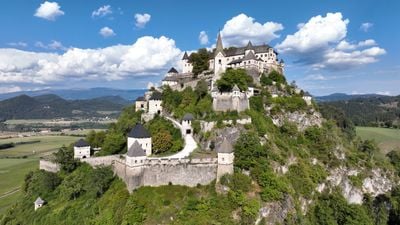
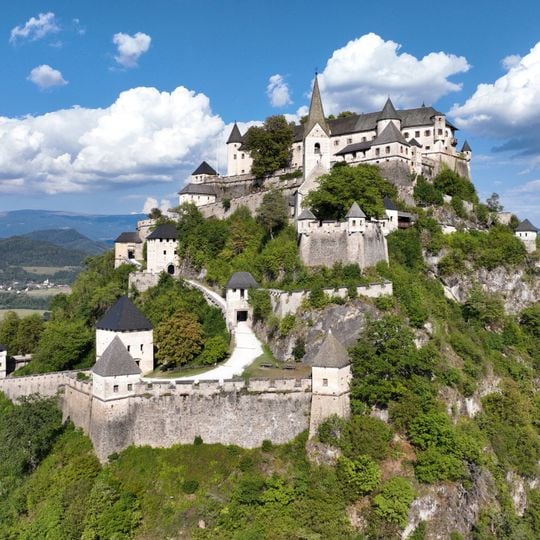
Hochosterwitz Castle sits on a dolomite rock rising about 172 metres above the surrounding country, with white-walled buildings and dark grey roofs clustered on the summit around a tall pointed spire. A winding path with a white balustrade climbs between the lower bastion, which has two square towers, and the upper complex. The gates along the way are built of red sandstone and green chlorite schist, set with white limestone or marble.
First documented in 860 as Astarwizza, when Louis the German donated the rock to the Archdiocese of Salzburg. From 1478 it passed to the Habsburgs, and in 1509 Emperor Maximilian I pledged it to Bishop Matthäus Lang. Georg Khevenhüller bought it in 1571 and built the fourteen gates between 1570 and 1586; his family still owns it.
The museum displays weapons, armor, and personal objects belonging to the Khevenhüller family, who lived here for over 500 years. These collections offer a window into the daily life of an aristocratic household across centuries.
Visitors walk a 620-metre path through all 14 gates to reach the castle; each gate displays a diagram of its defense mechanism. The castle can be reached by car or on foot from Launsdorf-Hochosterwitz train station, which connects to Klagenfurt. Parts of the castle are open from Easter to the end of October.
During a siege, the defenders threw their last ox over the walls to convince attackers that food supplies were still abundant. This trick was meant to weaken the attackers' morale and buy time.
The community of curious travelers
AroundUs brings together thousands of curated places, local tips, and hidden gems, enriched daily by 93,466 contributors worldwide.