Wotruba Church

Log in to your account

AroundUs is a community-driven map of interesting places, built by curious explorers like you. It grows with every review, story, and photo you share.
Connect to save your favorite spots, contribute locations, and create personalized routes.
By continuing, you accept our Terms and Conditions and our Privacy Policy
Add to collection
Map
Suggest a change
Share

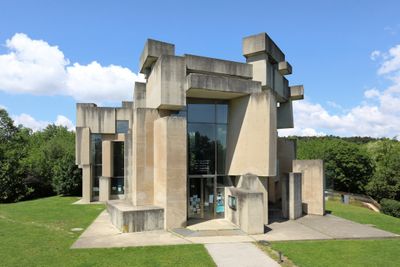
Wotruba Church, Brutalist church in Mauer, Austria

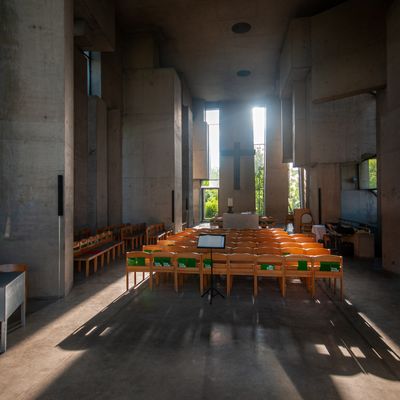
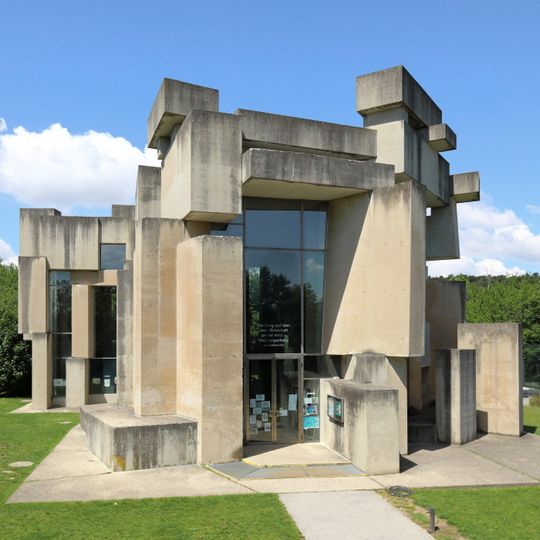
The Church of the Most Holy Trinity comprises 152 massive concrete blocks of varying dimensions arranged asymmetrically on a hillside in southern Vienna. Narrow gaps between blocks accommodate glass panels that channel natural light into the interior spaces. The structure rises in stepped formation toward its peak, resembling an abstract concrete sculpture. Interior spaces open upward with varying ceiling heights determined by the positioning of surrounding blocks.

Construction took place between 1974 and 1976 following designs by sculptor Fritz Wotruba on land formerly occupied by barracks during the Third Reich era. Wotruba died in 1975 before completion, with his student Josef Lackner and architect Fritz Gerhard Mayr overseeing the final execution. The consecration ceremony occurred on October 23, 1976. In subsequent decades the church became a reference work for postwar sacred architecture and continues to draw international attention.

This Catholic parish church serves both liturgical needs and attracts architecture enthusiasts who study its unconventional design language. Since the 1970s, the building has functioned as a meeting point for those interested in modern sacred spaces. The design sparked heated debate when first revealed but has gained recognition as an important contribution to contemporary ecclesiastical architecture within Austria and internationally.

The church sits on a hill in the Liesing district and can be reached by public transport from central Vienna. Visitors may view the interior during service times or by prior arrangement. The approach requires sturdy footwear due to the uphill path. No dining facilities operate nearby, so plan accordingly before visiting. The building measures 98 feet (30 meters) in length and 72 feet (22 meters) in width.

Individual concrete blocks vary dramatically in volume and weight, with the smallest measuring about 30 cubic feet (0.84 cubic meters) at 4,000 pounds (1.8 metric tons), while the largest reach 2,260 cubic feet (64 cubic meters) at 310,000 pounds (141 metric tons). These differences create shifting light conditions inside that change with time of day and sun position. Some blocks function as supports while others appear to float. Irregular spacing between elements produces dynamic patterns of light and shadow in constant transformation.

Location: Mauer

Location: Liesing

Inception: 1976

Architects: Fritz Wotruba, Fritz Gerhard Mayr

Architectural style: brutalist architecture, deconstructivism

Length: 30 m

Width: 22 m

Made from material: concrete

GPS coordinates: 48.14764,16.25344

Latest update: December 1, 2025 12:26

Brutalist architecture buildings : examples around the world

Brutalist architecture emerged in the decades following World War II, producing buildings that challenged conventional design through their honest expression of materials and function. From Le Corbusier's Unité d'Habitation in Marseille to Louis Kahn's National Assembly in Dhaka, these structures define a global movement that prioritized raw concrete, bold geometric forms and exposed construction elements. The style reached across continents, shaping university libraries in Chicago, government buildings in Boston and Chandigarh, residential towers in London, and cultural centers in São Paulo. Each building reflects the architectural philosophy of its time, when architects sought to create functional spaces through direct expression of structure and material. This collection documents examples from Europe, Asia, North and South America, representing the full range of building types that defined the movement. You'll find administrative complexes that house parliaments and municipal offices, educational facilities serving major universities, residential towers providing urban housing, and cultural institutions including museums and theaters. The structures share common characteristics—concrete left exposed to show its texture and formwork patterns, geometric compositions that emphasize mass and volume, and architectural elements that reveal rather than conceal how buildings stand and function. These sites offer insight into a period when architects reimagined how modern cities could be built and how public spaces could serve their communities.

Reviews

Visited this place? Tap the stars to rate it and share your experience / photos with the community! Try now! You can cancel it anytime.

« Wotruba Church - Brutalist church in Mauer, Austria » is provided by Around Us (aroundus.com). Images and texts are derived from Wikimedia project under a Creative Commons license. You are allowed to copy, distribute, and modify copies of this page, under the conditions set by the license, as long as this note is clearly visible.

Discover hidden gems everywhere you go!

From secret cafés to breathtaking viewpoints, skip the crowded tourist spots and find places that match your style. Our app makes it easy with voice search, smart filtering, route optimization, and insider tips from travelers worldwide. Download now for the complete mobile experience.

Around Us App Screenshot

A unique approach to discovering new places

Le Figaro

All the places worth exploring

France Info

A tailor-made excursion in just a few clicks

20 Minutes