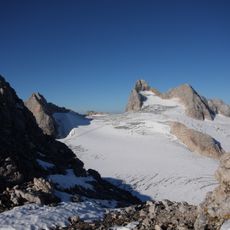
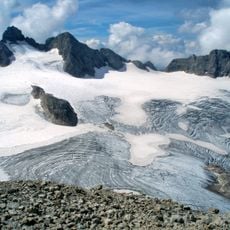
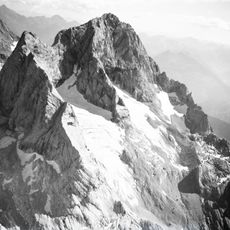
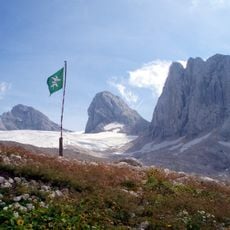
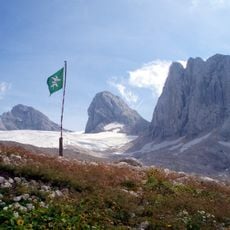
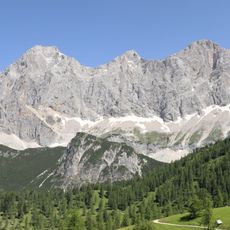
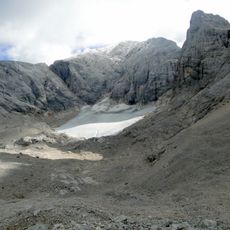
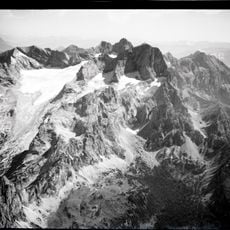
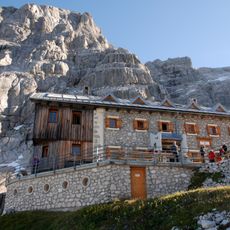
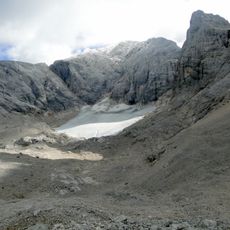
Bischofsmütze, Mountain summit in Salzburg, Austria.
Bischofsmütze is a summit in the Gosaukamm range of the Dachstein Mountains, reaching an elevation of 2,458 meters (8,065 feet). The mountain features two distinct peaks, with the larger one standing alongside the Kleine Bischofsmütze.
The first ascent was made on 28 June 1879 by Johann Schrempf, known as Auhäusler, and Johann Steiner. The mountain's name comes from its twin-peaked shape, which recalls a bishop's mitre, and it marked the border between the Erzherzogtum Österreich and the Erzbistum Salzburg. A massive rockfall on 22 September 1993 broke off a 200-metre pillar, about 100,000 cubic metres of rock with a mass of 250,000 tonnes, and further collapses followed in 1999 and 2001.
The mountain's name comes from its shape, which resembles a bishop's mitre, the ceremonial headdress worn by Catholic bishops. Visitors can recognize this distinctive outline from various viewpoints around the region.
The ascent approaches from the south through the Mützenschlucht and requires technical climbing skills along with proper equipment such as ropes and anchors. Only experienced mountaineers with rock climbing experience should attempt this route.
On 22 September 1993 a single massive rockfall broke off a 200-metre pillar, about 100,000 cubic metres of rock with a mass of 250,000 tonnes. Further collapses followed in 1999 and 2001, and since 2001 critical parts of the summit have been surveyed for movement.
The community of curious travelers
AroundUs brings together thousands of curated places, local tips, and hidden gems, enriched daily by 94,043 contributors worldwide.