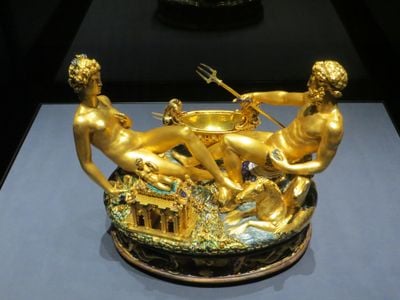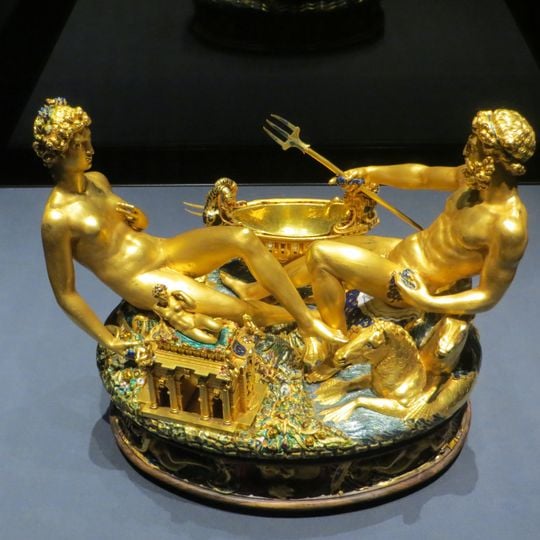
Cellini Salt Cellar, Gold salt cellar in Kunsthistorisches Museum, Austria
The Cellini Salt Cellar is a gold sculpture in the Kunsthistorisches Museum Vienna that was made as a tabletop centerpiece for holding seasonings. The work shows two reclining figures on an oval base made of ebony and ivory, with both bodies rendered in full anatomical detail.
Benvenuto Cellini completed the salt cellar in 1543 for King Francis I of France, working from wax and silver models first made for Cardinal Ippolito d'Este, who had withdrawn his commission. In 1570 Charles IX of France gave it to Archduke Ferdinand II of Tyrol as thanks for standing in as his proxy at his wedding to Elisabeth of Austria. It was long kept anonymously at Schloss Ambras before reaching the Kunsthistorisches Museum in Vienna.
Cellini named the piece Saliera and gave each figure a role: Neptune, god of the sea, guards the salt, while Tellus, goddess of the earth, holds the pepper temple and a cornucopia. The base carries allegories of the times of day and the winds, and a salamander under Tellus's foot was Francis I's personal emblem. The work was meant to spark learned conversation at court banquets.
The salt cellar is displayed in the Kunstkammer of the Kunsthistorisches Museum Vienna, in a case that lets you walk around it. Look for the four ivory balls under the ebony base, which once let it roll across a banquet table, and the salamander beneath Tellus's left foot, the emblem of Francis I.
The salt cellar was stolen in 2003 and recovered three years later buried in a lead box in a forest northeast of Vienna. The figures were not only decorative but the recesses beside them actually held salt and pepper for the royal table.
The community of curious travelers
AroundUs brings together thousands of curated places, local tips, and hidden gems, enriched daily by 92,887 contributors worldwide.