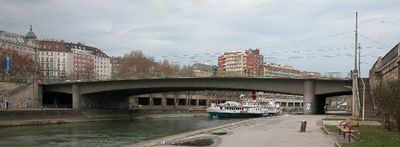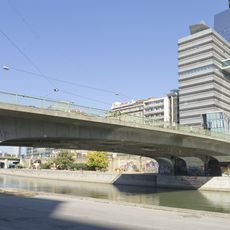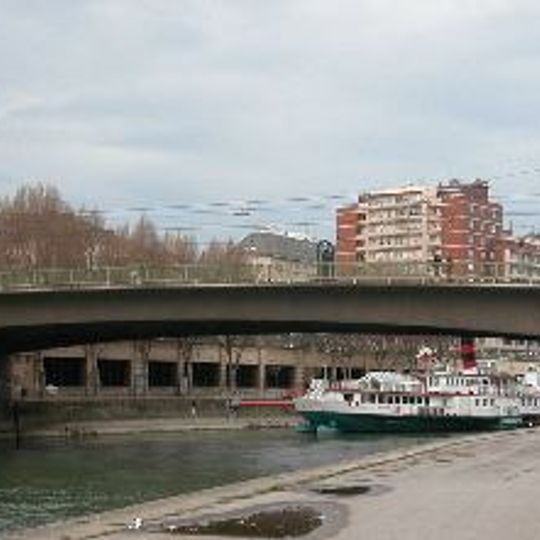
Marienbrücke, Tram and road bridge in Leopoldstadt district, Vienna, Austria
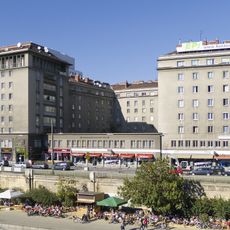
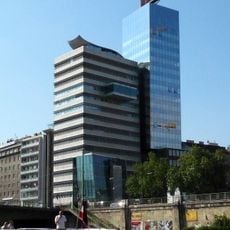
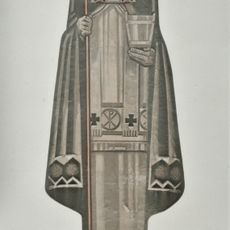
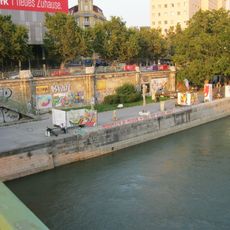
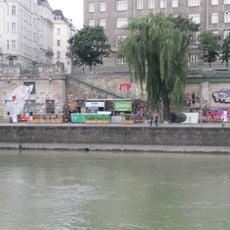
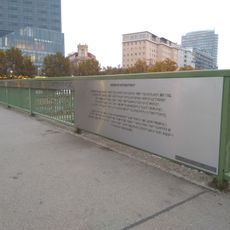
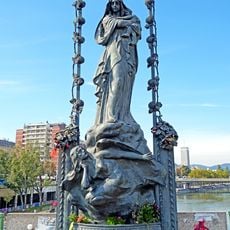
The Marienbrücke is a road and tram bridge over the Donaukanal, linking Vienna's Innere Stadt and Leopoldstadt districts at the northern end of Schwedenplatz. Built between 1951 and 1953 to designs by Karl Jäger, it was the first large reinforced-concrete bridge in the Vienna area and is five metres wider than its predecessor. A simplified replica of Hans Schwathe's Jugendstil Madonna stands at the bridge centre.
A first Marienbrücke was built between 1905 and 1906 as a steel arch bridge to plans by Josef Hackhofer and Albert Hans Pecha; Otto Wagner had entered a losing design, the "Vindobonabrücke", in the 1904 competition. The bridge was blown up in April 1945 during the Battle of Vienna. The present reinforced-concrete bridge, the first large one of its kind in the Vienna area, was built between 1951 and 1953 to plans by Karl Jäger and opened on 25 October 1953 by Mayor Franz Jonas.
The bridge serves as a daily crossing point for Viennese commuters moving between neighborhoods on tram lines and in cars. It demonstrates how public transit and vehicle traffic coexist as ordinary parts of city life.
The bridge is accessible around the clock to pedestrians and vehicles from both sides of the Donaukanal. It is useful to know that trams run regularly, which means visitors should expect crowded trains during peak hours.
The structure dates from the 1950s and still displays the engineering solutions from that era, which made it possible to fit two different types of traffic in a tight space. Walking across the bridge, visitors can observe how this early engineering work functions under today's traffic loads.
The community of curious travelers
AroundUs brings together thousands of curated places, local tips, and hidden gems, enriched daily by 94,031 contributors worldwide.