Burggrabenklamm, Narrow canyon and natural monument in Sankt Gilgen, Salzburg, Austria
Burggrabenklamm is a narrow canyon in Salzburg with towering limestone walls carved by a flowing stream. The passage features natural pools and cascading drops where water has slowly worn through the rock.
The gorge was opened for tourism in the 19th century during the Salzkammergut summer-resort era; from 1869 the Attersee shipping service called at Burgbachau. In 1890 the k.u.k. forester Alois Schönherr from Unterach built the Valerie-Weg, named after Archduchess Valerie. A metal suspension bridge about 270 m long, completed in 2015, was removed in 2020 after avalanche and rockfall damage, so the gorge can now be seen only on a canyoning tour.
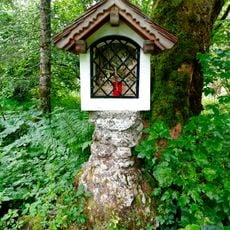
The name Burggraben refers to the stream and the ravine it cuts; the lower section alone is called Burggrabenklamm. The Valerie-Weg, laid out in 1890 by forester Alois Schönherr of Unterach, is dedicated to Archduchess Valerie. At the entrance stands a statue of Maria Klamm, the Klamm-Madonna. Since the footpath was removed in 2020, the gorge can be seen only on a canyoning tour.
The valley lies in the municipality of Sankt Gilgen, on the southern shore of Lake Attersee; the stream enters the lake at Unterburgau, 489 m above sea level. The old valley path was closed by the authorities in 2009, reopened on the Valerie-Weg in summer 2010, and the metal footbridge built in 2015 was removed in 2020. Since then the gorge can only be seen on a guided canyoning tour.
The 18-metre waterfall at the end of the gorge drops into a rock basin. A metal suspension bridge about 270 metres long once carried hikers through the gorge from 2015, but avalanches and rockfalls damaged it in its first winter, and the structure was dismantled in 2020. Since then the gorge can only be seen on a canyoning tour.
The community of curious travelers
AroundUs brings together thousands of curated places, local tips, and hidden gems, enriched daily by 93,620 contributors worldwide.