Nibelungen Bridge, Road and tram bridge in Linz, Austria
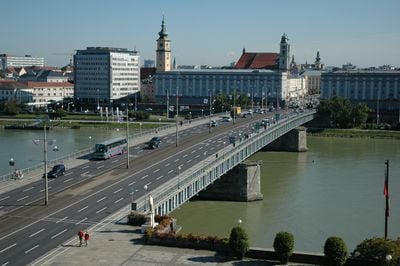
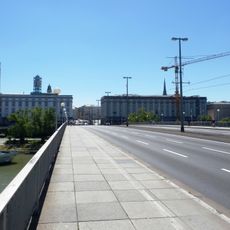
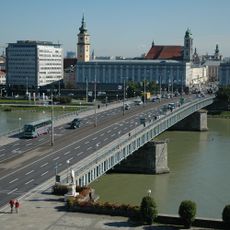
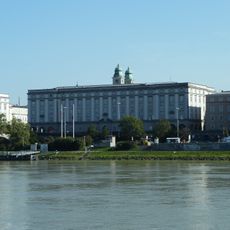
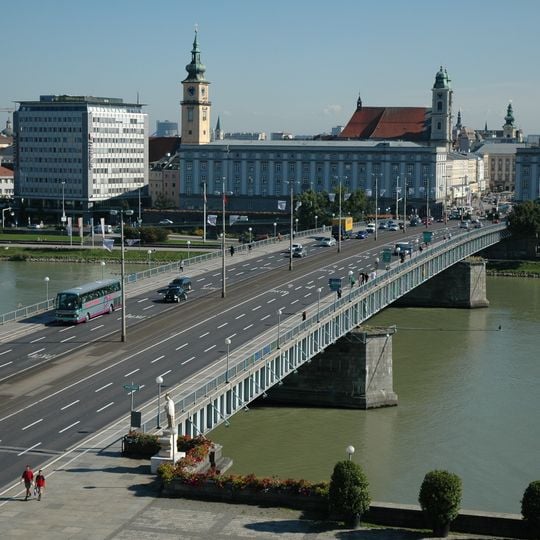
The Nibelungen Bridge is a 250 m long, 30 m wide full-girder bridge with three openings, carrying six lanes and tram tracks over the Danube between Innenstadt and Urfahr. It rests on two concrete piers, with a 90.1 m passage width between them. Pale railings line the deck, and a raised walkway with a low parapet runs along the side.
Built from 1938 to 1940 to plans by engineer Karl Schaechterle and architect Friedrich Tamms, with Werner Sarlay supervising, the bridge replaced a wooden crossing first permitted by Maximilian I in 1497 and an iron bridge of 1872. The planned equestrian statues of Siegfried, Kriemhild, Gunther and Brunhild were never made.
The bridge takes its name from Germanic legend and connects two districts that thousands of people cross daily. It has become a natural part of the city's geography, viewed by locals as an ordinary gateway between neighborhoods.
The bridge is easily accessible by public transportation, especially by tram lines that connect the center with the north. Pedestrians and cyclists can also cross the structure and enjoy views over the river.
The granite slabs on the walkways are about one metre square. The bridge was meant to carry four equestrian statues of Nibelung figures, 6.5 m tall, commissioned from sculptor Bernhard Graf Plettenberg; the war prevented their execution. During a guided tour, plaster 1:1 models of Kriemhild and Siegfried stood on the bridge for a few months.
The community of curious travelers
AroundUs brings together thousands of curated places, local tips, and hidden gems, enriched daily by 92,798 contributors worldwide.