Palace of Ludwig Viktor, City palace and theatre in Innere Stadt, Austria
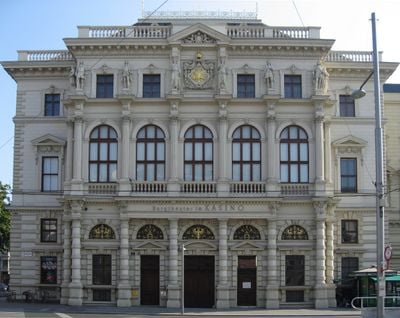
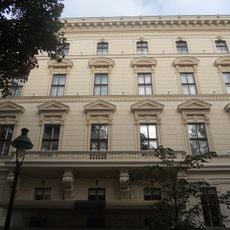
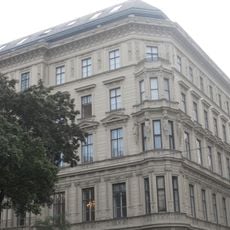
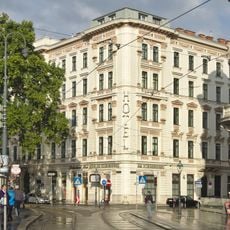
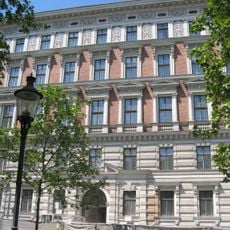
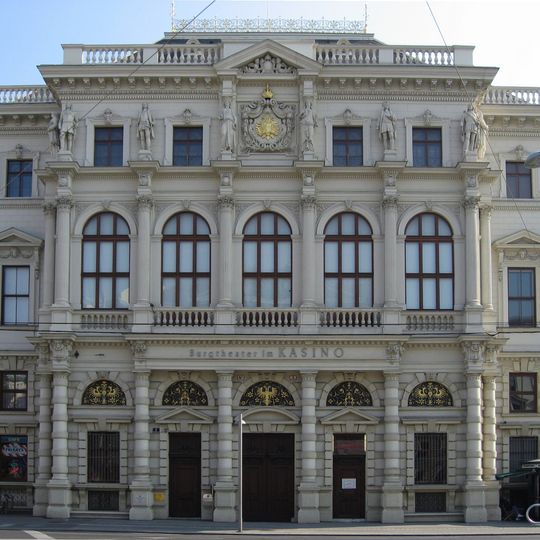
The Palace of Ludwig Viktor at Schwarzenbergplatz 1 has a pale cream stone and stucco facade with a roof balustrade and a central gable bearing a gold crest of two eagles and a shield. The piano nobile has four tall round-arched windows with balustraded sills, and the ground floor has three round-arched doorways beneath a frieze of gold medallions. The facade reads "Burgtheater im KASINO".
Built between 1863 and 1866 by architect Heinrich von Ferstel, the palace was commissioned for Archduke Ludwig Viktor, the younger brother of Emperor Franz Joseph I. The building took shape during a period of major urban transformation in Vienna and has defined the character of Schwarzenbergplatz ever since.
The palace's large festival hall serves as a rehearsal and performance venue for the Burgtheater, as the facade inscription "Burgtheater im Kasino" indicates. Under director Matthias Hartmann (2009–2014) it became a central stage of the national theatre; he staged Krieg und Frieden (2011), Troja (2012) and Die Ahnfrau (2013) here.
The palace is not open to the public. The Burgtheater uses the former ballroom as a studio stage, with performances announced in its programme; the ministry and rented offices are not accessible. Visitors can view the facade from Schwarzenbergplatz and the Schubertring side.
The six 2.5-metre statues on the top floor depict Niklas Graf Salm, Ernst Rüdiger Graf Starhemberg, Ernst Gideon von Laudon, Joseph von Sonnenfels, Johann Bernhard Fischer von Erlach and Prince Eugene of Savoy. They were carved by Franz Melnitzky and Josef Gasser. Above them, the archduke's coat of arms is flanked by caryatids and closed by a triangular gable.
The community of curious travelers
AroundUs brings together thousands of curated places, local tips, and hidden gems, enriched daily by 92,783 contributors worldwide.