Villa Wagner I, Early 20th century artist residence in Penzing, Vienna, Austria.
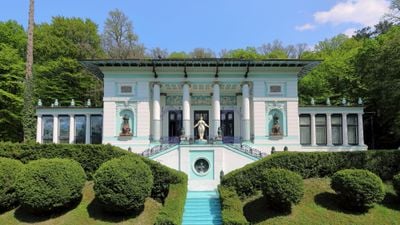
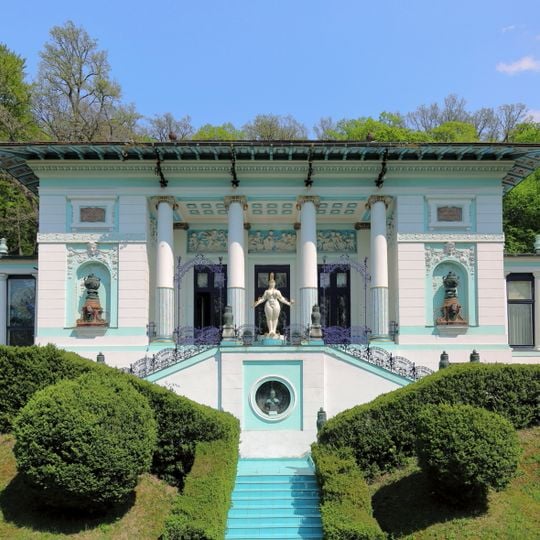
Villa Wagner I is a late-historicist country house built 1886–1888 to Otto Wagner's own plans on Hüttelbergstraße in Hütteldorf, now part of Penzing. A central portico with four fluted Ionic columns and a bracketed cornice dominates the pale blue and white facade; symmetrical staircases with blue balustrades descend to a landing, and two fountain niches flank the entrance. A metal female statue by Ernst Fuchs stands at the top of the steps.
Otto Wagner built the villa between 1886 and 1888 as a summer residence at the edge of the Vienna Woods in Hütteldorf. The family lived there year-round from 1895, and in 1911 Wagner sold it to Ben Tieber, director of the Apollo Theatre. In 1938 Baldur von Schirach seized it for the Hitler Youth; after the war it stood threatened with demolition until Ernst Fuchs bought it in 1972.
The villa became a meeting point of the Vienna Secession, counting Gustav Klimt, Josef Hoffmann and Gustav Mahler among its guests. Its name changed with each owner: Otto-Wagner-Villa, Ben-Tieber-Villa, then Ernst-Fuchs-Villa. Since 1988 it has housed the Ernst Fuchs Private Museum, directed by Cornelia Mensdorff-Pouilly.
The building is protected as a heritage landmark and can be easily reached from Vienna. Visitors should note that it is a private residence and can only be viewed from the outside.
At the top of the outdoor staircase stands a metal female statue made by Ernst Fuchs, who bought the ruined villa in 1972 for 14 million schillings and set up his studio here. He renovated it with architect Friedensreich Hundertwasser and painter Arnulf Rainer.
The community of curious travelers
AroundUs brings together thousands of curated places, local tips, and hidden gems, enriched daily by 92,765 contributors worldwide.