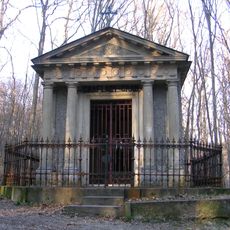
Wienerwald-Heldendenkmal, War memorial in Klosterneuburg, Austria
Wienerwald-Heldendenkmal is a massive round structure 12 metres high on a circular base 14 metres in diameter, built in 1916 near the Vienna city limits on Weidlingbach municipal land. Its dome appears to rest on twelve columns and carries a lantern topped by a helmet decorated with laurel and oak leaves. About 186 cubic metres of rubble and artificial stone and 18 tonnes of Portland cement went into it.
Built in 1916 by Austro-Hungarian soldiers in their free time under Landsturm Lieutenant Engelbert Robert Tula, on land lent by Prince Johann Schwarzenberg in today's Schwarzenbergpark. Tula reported the finished work to the War Ministry and asked for a consecration with a military chaplain and band; the ministry praised the patriotic act but reprimanded him for bypassing official channels, forbade the sale of his commemorative booklet and postcards, and made him repay the men's donations. After 1918 the neglected meadow grew over and plants rooted on the structure. Vienna, which bought the park in 1958, planned to demolish the dilapidated monument; the Austrian Kameradschaftsbund renovated it instead, and war-archive documents identified the builder and the partly illegible inscriptions. It was reinaugurated on 24 May 1970 with Colonel Josef Gerstmann and Tula's daughter present.
The monument's inscriptions are its cultural core: the original texts honour the homeland's defenders, name Lieutenant Engelbert Tula and the men of Landsturm-Abteilung I/IV, Hameau, as builders in 1916, and dedicate the memorial to the fallen of Austria-Hungary, Germany, Turkey and Bulgaria. Two plaques added in 1970 record the restoration by the Austrian Kameradschaftsbund with the army and the municipalities of Vienna and Klosterneuburg.
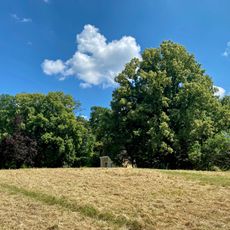
The memorial stands on Schwarzenbergpark ground in Weidlingbach, on the Klosterneuburg side of the Vienna boundary. It is an outdoor structure with no gate or staffed entrance, so it can be viewed at any time of day. The site is reached on foot along park paths; the round base and surrounding trees make it easy to locate from the meadow.
The monument is probably the earliest World War I memorial for fallen soldiers, built together with a 1915 memorial on the Fath-Höhe on the Bisamberg, also planned by Tula and converted into an Eichendorff memorial in 1957. A bronze laurel wreath with ribbon on the base and a heavy iron chain carried by 10 columns around the memorial disappeared in the interwar period.
The community of curious travelers
AroundUs brings together thousands of curated places, local tips, and hidden gems, enriched daily by 93,785 contributors worldwide.