Pfarrkirche Maiersdorf, Protected parish church in Hohe Wand, Austria.
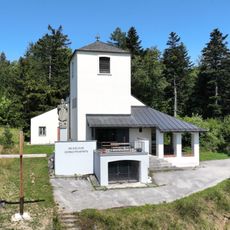
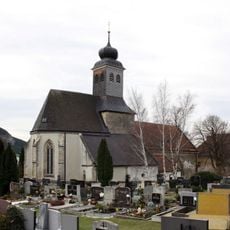
Pfarrkirche Maiersdorf stands on a rock terrace below the Hohe Wand ridge. Its two-storey Romanesque choir tower carries a small roof-turret bell tower, and the tall two-storey nave is built of regular ashlar blocks on a foundation of Pietra Rasa masonry. The upper storey is a 14th-century Gothic defensive addition with herringbone compartments and slit loopholes; the north wall has no windows.
The Romanesque church of the 12th century was later topped with a Gothic defensive upper storey. According to Erwin Reidinger's astronomical study, the choir was oriented to the rising sun on Easter Sunday, 24 April 1177 (Julian date). The church is recorded in 1379 as a filial church of Muthmannsdorf; in 1783 Maiersdorf was cut from the Muthmannsdorf parish and raised to an independent parish.
The parish is dedicated to John the Baptist, to whom the high altarpiece by Franz Josef Dobiaschofsky (1848) is devoted. Since 1881, when Neukloster was united with Heiligenkreuz Abbey, priests from the Wienerwald monastery have served the parish. The church has been an independent parish since 1783, when it was cut from the Muthmannsdorf district.
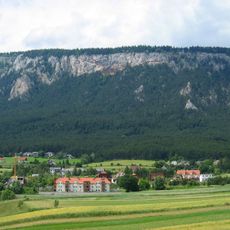
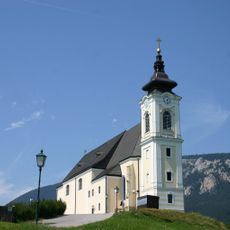
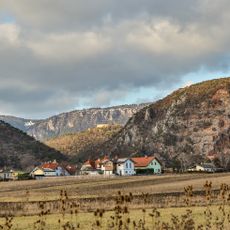
The church stands on a rock terrace in front of the Hohe Wand ridge, visible from afar. The west annex with a hipped roof and the north sacristy, both built in 1964, mark the entrance side. The nave's north wall has no windows, so the interior light comes from the south.
The upper storey is a 14th-century Gothic defensive addition in layered masonry with herringbone compartments, pierced by slit-like loopholes beneath the eaves; the north wall has no windows at all. A high south-side entrance in the choir tower points to the building's former role as a fortified church.
The community of curious travelers
AroundUs brings together thousands of curated places, local tips, and hidden gems, enriched daily by 93,974 contributors worldwide.