Glockenspiel, Carillon in the Neue Residenz on Residenzplatz, Salzburg, Austria
The Glockenspiel is a musical instrument comprising 35 bells spanning three octaves, housed in the tower of the Neue Residenz in central Salzburg. A mechanical system controls the instrument and enables its daily concert performances to play automatically.
In 1695 Prince-Archbishop Johann Ernst von Thun bought 35 bells cast in Antwerp in 1688–89; packed in straw, they reached Salzburg by cart in 1696. The tower was raised in 1701/02 and widened to carry their weight, and in early 1703 court clockmaker Jeremias Sauter was finally commissioned to build the baroque mechanism. The bells were removed in 2008 and the drive in spring 2009, restored in Vienna for over €400,000, with the historic mechanical drive made usable again.
The 35 bells ring melodies such as Papageno's "Das klinget so herrlich" from The Magic Flute and "Reich mir die Hand mein Leben" from Don Giovanni, arranged for the carillon in the 19th century. Sixteen pieces come from Johann Michael Haydn or are attributed to him; folk songs like "Ännchen von Tharau" and "Stille Nacht" are also played.
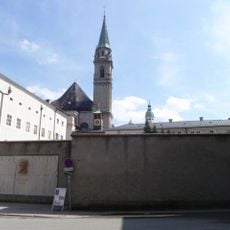
The carillon is in the tower of the Neue Residenz on Residenzplatz, in Salzburg's old town. Its 35 bells hang in the eight arched openings of the top storey, arranged in rows of two and three, and the wooden upper structure was built to absorb their vibrations. The tower was raised in 1701/1702 and widened so it could carry the bells' weight.
The playable wooden barrel is 2.5 m in diameter and 1.5 m wide, and the whole mechanism weighs over six tonnes. About 50 pieces are set on it, sixteen by or attributed to Johann Michael Haydn. The bells hang in the tower's eight arched openings in rows of two and three.
The community of curious travelers
AroundUs brings together thousands of curated places, local tips, and hidden gems, enriched daily by 93,469 contributors worldwide.