Roman bridge in Ilidža, Stone bridge in Ilidža, Bosnia and Herzegovina
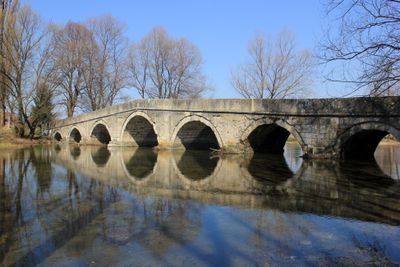
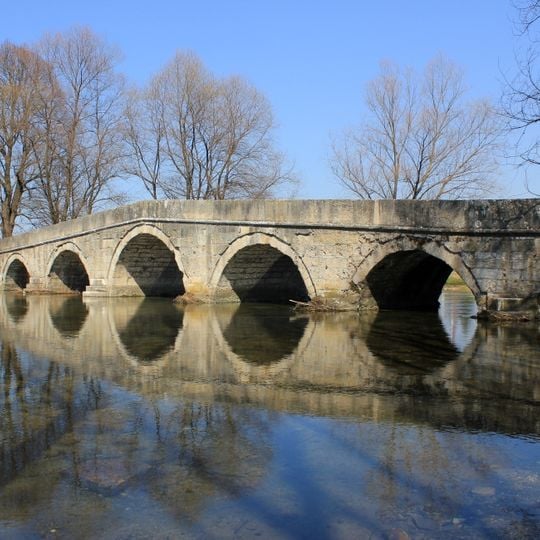
The Roman bridge in Ilidža is a low stone structure of seven semicircular arches over the Bosna River, built from dressed stone blocks probably taken from the nearby Roman settlement of Aquae Sulphurae. The arches are lower at the ends and rise toward the middle, giving the bridge a slightly convex profile. Its length is given as 52.10 m, width with the cornice 4.55 m, height about 4.50 m, and the eastern approach ramp measures 85.30 m. Six river piers carry the bridge; those on the upstream side have cutwaters, and the third pier downstream is reinforced by a stone buttress.
Benedikt Kuripešić, passing through in 1530, did not mention the bridge, but around 1550 the Venetian envoy Katarin Zeno described a seven-arched stone bridge over the Bosna. It was therefore built between 1530 and 1550, though neither its patron nor its builder is known. Rustem Pasha-Hrvat had it repaired around 1762 at the request of Sarajevo's residents.
The name comes from a shallow relief on a stone slab set into the downstream parapet: a nude standing figure with the left leg crossed over the right, the right arm raised above the head and the left arm across the chest. The slab is a Roman spolium, and the sources record no data on the relief itself.
The bridge stands beside the main road from Blažuj to Ilidža, on the right-hand side when driving, and can be reached on foot from the road. The old route it carried is now abandoned, so the crossing itself is no longer part of the through road. Its eastern approach ramp is 85.30 m long.
Although its name suggests Roman origins, this bridge was actually built during the Ottoman period. This confusion arose because builders reused Roman stones, which gives the structure a special historical character.
The community of curious travelers
AroundUs brings together thousands of curated places, local tips, and hidden gems, enriched daily by 94,333 contributors worldwide.