Tajhat Palace, Indo-Saracenic palace and museum in Rangpur District, Bangladesh
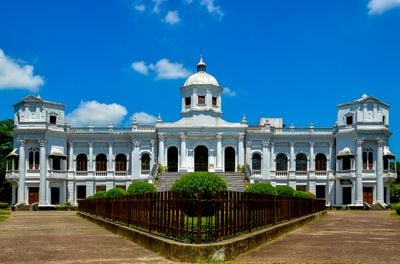
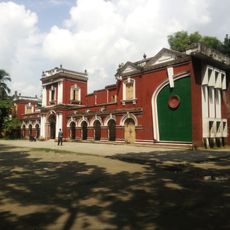
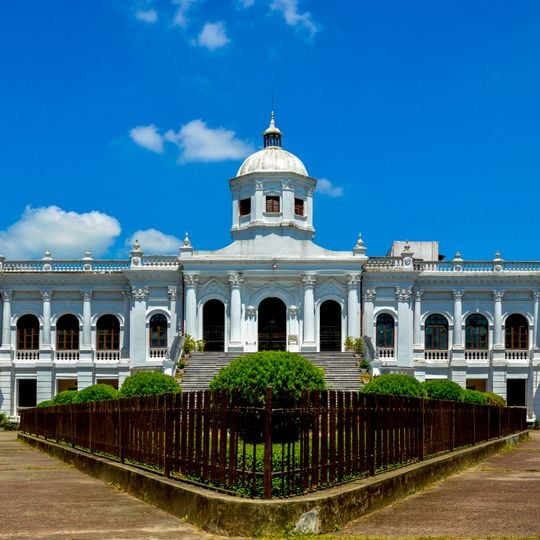
Tajhat Palace is a two-storey building facing east, about 76 metres wide, with a central projecting porch and a ribbed conical dome on a tall octagonal neck. A broad staircase of imported white marble rises above the porch, and a balustrade runs along the roofline. The ground floor has an arcade of round-headed arches, and the palace is laid out in a U shape around a large hall.
Maharaja Kumar Gopal Lal Roy, a goldsmith by trade, built the palace at the start of the 20th century; construction took about ten years. The estate is said to take its name from his jewelled crown, or taj. From 1984 to 1991 the building housed a branch of the Supreme Court of Bangladesh, and in 1995 it was declared a protected monument.
The name Tajhat comes from the jewelled crown, or taj, of Maharaja Kumar Gopal Lal Roy, a goldsmith by trade. The museum on the upper floor holds 10th–11th century terracotta artefacts, Sanskrit and Arabic manuscripts including copies of the Mahabharat, Ramayan and a Quran attributed to the Mughal emperor Aurangzeb, and black stone carvings of Vishnu.
The palace is located a short drive from Rangpur city and can be reached by car without difficulty. Visitors should note that exhibition spaces operate on specific schedules and photography is restricted in certain areas.
A rear staircase, now closed for safety reasons, is said by local tradition to connect to a tunnel running to the Ghaghat River. The palace fountain, built specially for the queen, still shows traces of its white marble and greenish patterns despite fading.
The community of curious travelers
AroundUs brings together thousands of curated places, local tips, and hidden gems, enriched daily by 93,378 contributors worldwide.