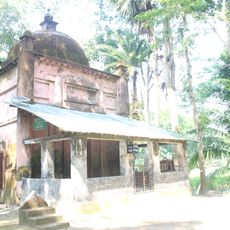
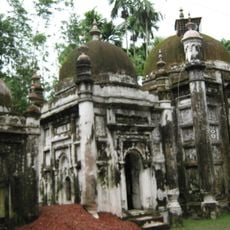
Momin Mosque, Wooden mosque in Mathbaria Upazila, Bangladesh.
Momin Mosque is a rectangular wooden prayer hall measuring 7.47 by 3.55 metres, with 15-centimetre-thick walls and a double-leaf door on the east. Its four-sided chouchala roof is covered with corrugated iron sheets, and a raised central apex topped by a dochala aids ventilation. Six five-inch square posts on each long side and three on each short side support the roof frame.
Momin Uddin Akon began building the mosque in 1913 after finding the distance to the nearest mosque burdensome. He first made bricks in his backyard, then switched to wood to match Burirchar's wooden houses. Artisans, mainly from Swarupkati, completed the work in about seven years. In 2003 the Department of Archaeology listed it as a national heritage site, and restoration began in 2008.
Momin Uddin Akon directed the plans, designs, colours and calligraphy himself, drawing on his knowledge of Arabic and Islamic culture. Two calligraphic inscriptions are fixed above the main entrance and over the mihrab; the frontal one, on the right of the entrance, carries the construction period in Bengali. The carved motifs include pineapples, flowers, leaves, geometric perforations and nasta'liq calligraphy.
The prayer hall is entered from the east through a double-leaf door; the qibla wall opposite has a projected mihrab. The building stands on a high plinth, so expect a step up. The walls hold fixed perforated screens and swing and pivotal windows operated from inside, which ventilate the space.
The entire structure was built without using any nails, utilizing wood from Chittagong and Myanmar to create a solid framework. This construction method shows advanced wood-joining techniques that were uncommon at the time.
The community of curious travelers
AroundUs brings together thousands of curated places, local tips, and hidden gems, enriched daily by 94,048 contributors worldwide.